Cuéntamo Blog

Accounting tips for freelancers and households

Cuéntamo Blog

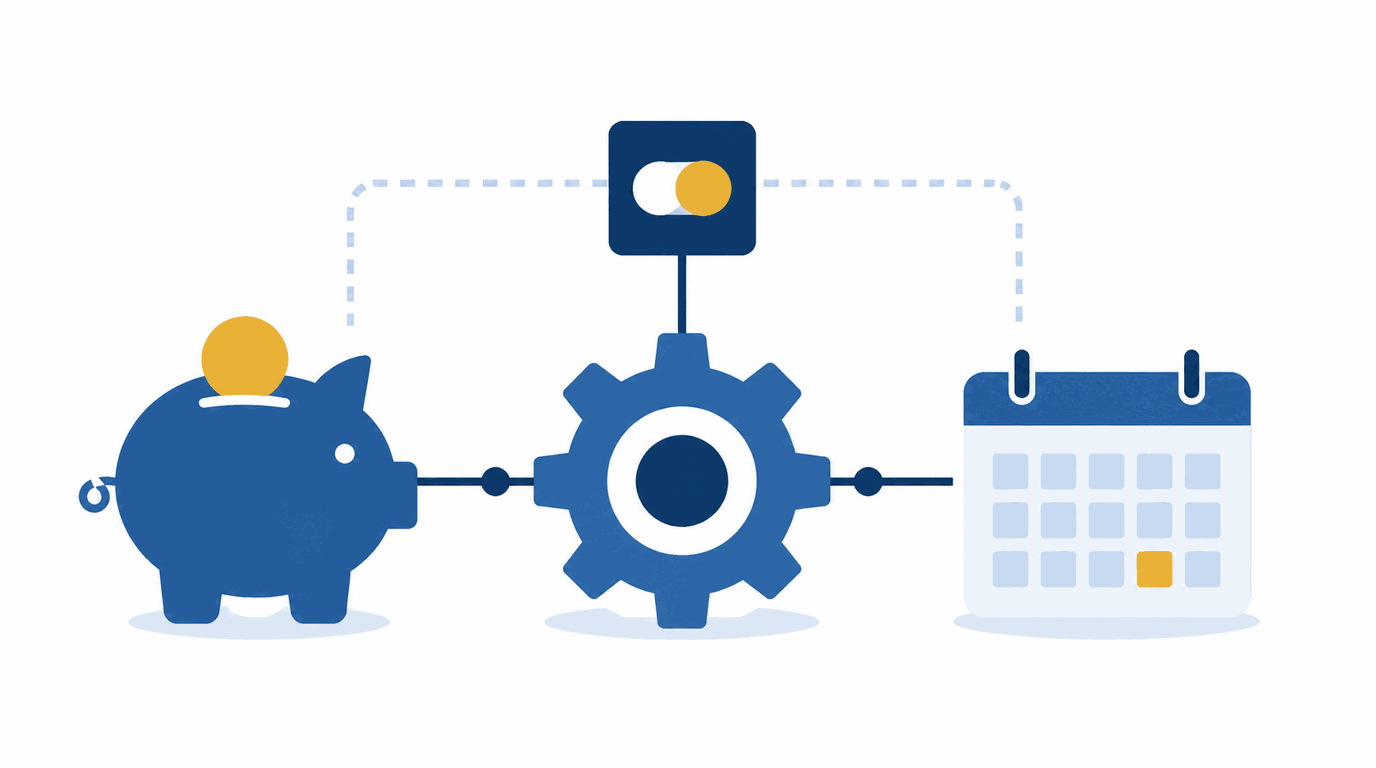
Automate it so it doesn't depend on willpower

September 3, 2026

You decide to save more, stop impulse buying, or never pay a bill late again. It works for two weeks. Then a rough month shows up, you let your guard down for one day, and the resolution quietly fades without you ever deciding to give up. It’s not that you lack willpower: you’re using it on the wrong job.

The tip: let the system decide, not you every time

Willpower is a resource that runs out. Every decision you have to make again — do I set money aside this month? do I pay this bill now or later? do I buy this or not? — is a chance for the easy path to win. An automatic system never gives you that chance: the decision is already made once, and it runs on its own whether you remember or not, whether you’re having a good day or a terrible one.

Cuéntamo Blog

Modelo 390: What Spain's Annual VAT Summary Is and How It Ties to Your Quarterly Returns

August 28, 2026

Four quarterly modelo 303 returns, four payments to the Agencia Tributaria, and then at the end of the tax year comes one more declaration: the modelo 390. For many autónomos (self-employed workers) this is the one that generates the most questions — not because it’s complicated, but because it’s not clear what it’s actually for if you’ve already filed all four 303s for the year.

The short answer: the 390 is not a new tax payment. It’s the year-end close. The document that says “here’s everything I charged, everything I paid, and everything I’ve settled with the tax authority over the year, added up”. It’s also your last chance to spot anything in the quarterly returns that doesn’t add up.

Cuéntamo Blog

Pay yourself first: automate your savings on payday

August 27, 2026

You get paid, cover the usual bills, and at the end of the month you look at whatever’s left to “save.” Most months there isn’t much, and some months there’s nothing. The problem isn’t that you earn too little or spend badly: it’s the order. If savings go last in line, they lose to whatever expense shows up first.

The tip: flip the order

The idea fits in one sentence: treat savings like just another fixed bill, not like whatever’s left over. Instead of spending and seeing what remains, set aside a fixed amount first — an automatic transfer, the same day or the day after you get paid — and live on what’s left afterward. Money that never reaches your everyday checking account is money you won’t spend without noticing.

Cuéntamo Blog

Deducting the car, the phone and the home as a freelancer: what the tax office accepts (and what it doesn't)

August 25, 2026

Some freelance expenses raise no doubt at all: office supplies, the software you use every day, your accountant. Then there are the car, the phone and the home, which happen to be the things you use for everything: for work and for life. That’s where almost every freelancer hesitates, and where the two opposite mistakes happen: deducting nothing out of fear, or deducting too much without realizing you’re taking on a real risk.

Cuéntamo Blog

A till receipt is not an invoice: when you can deduct it and when you can't

August 24, 2026

You have lunch with a client, pay 48 euros and tuck the receipt into your wallet with a sense of duty done. Three months later, doing your quarterly return, that crumpled piece of paper is worth rather less than you thought: you can deduct the expense, but not the VAT. And not because the receipt is faulty, but because it’s missing one line you can only ask for at the moment you pay.

Cuéntamo Blog

Project your end-of-month balance (and act before it happens)

August 20, 2026

You open your banking app, see 1,400 in your account, and relax. The problem is that number only tells you how much you have today, not how much you’ll have on the 28th, once rent, the electricity bill, and the gym membership have all gone out. Looking only at today’s balance is like driving while staring at the rearview mirror: it tells you where you’ve been, not what’s ahead.

The tip: project, don’t just look

The idea is simple and doesn’t need any complicated tool: instead of asking “how much do I have?”, ask “how much will I have on the last day of the month?” To answer that, you only need two lists you already know by heart:

Cuéntamo Blog

How to pay yourself a salary as a freelancer (without spending the tax money)

August 19, 2026

When you’re an employee, a fixed number lands in your account on payday. You know exactly what you have to work with, and everything else (taxes, social security) has already been taken out without you having to think about it. When you go freelance, that fixed number disappears. A client pays you 1,200 and, if you’re not careful, that 1,200 “feels like yours” the same day it lands in your account. It isn’t. Part of it has to go back out in taxes, another part covers business costs, and only what’s left after that is, genuinely, your salary.

Cuéntamo Blog

Latte-factor spending: the small leaks that drain your account

August 17, 2026

You go over the month and there’s no single big expense that explains it. No emergency, no unusual purchase. And yet the numbers still don’t add up the way you expected. Chances are the problem isn’t a big expense at all, but a leak of small ones: the coffee on the way to work, the app that renews itself, Thursday’s takeout order because you didn’t feel like cooking. Each one looks harmless on its own. Together, they’re the difference between saving something and saving nothing.

Cuéntamo Blog

Renting out a flat in Spain: what you really pay, and the expenses almost nobody claims

August 13, 2026

Renting out a flat looks like the easy part: you sign the contract, you collect every month, and that’s it. The complicated bit shows up in the tax return, and almost always for two opposite reasons: many people assume that money is taxed lightly (it’s taxed at their highest rate) while at the same time leaving out expenses the law grants them, starting with the biggest one of all, which doesn’t cost them a euro a year.

Cuéntamo Blog

Pay Down Your Mortgage or Invest €10,000? The Real Math, Step by Step

August 10, 2026

You get €10,000 out of nowhere. A big bonus, a small inheritance, a severance payment, savings that have finally added up. And the usual dilemma shows up: do you use it to pay down the mortgage, or do you invest it?

The answer you’ll find almost everywhere is “it depends.” True, but not very useful. Let’s do the real math with numbers, so you know exactly what you’re comparing and which part of the decision isn’t math at all, but how well you sleep at night.