Recurring household expenses: how to find out what you really spend each month
If I asked you how much you spend each month, you’d probably give me a reasonably close figure. Rent or mortgage, groceries, utilities, maybe the car. You know those costs well because they’re visible and frequent.
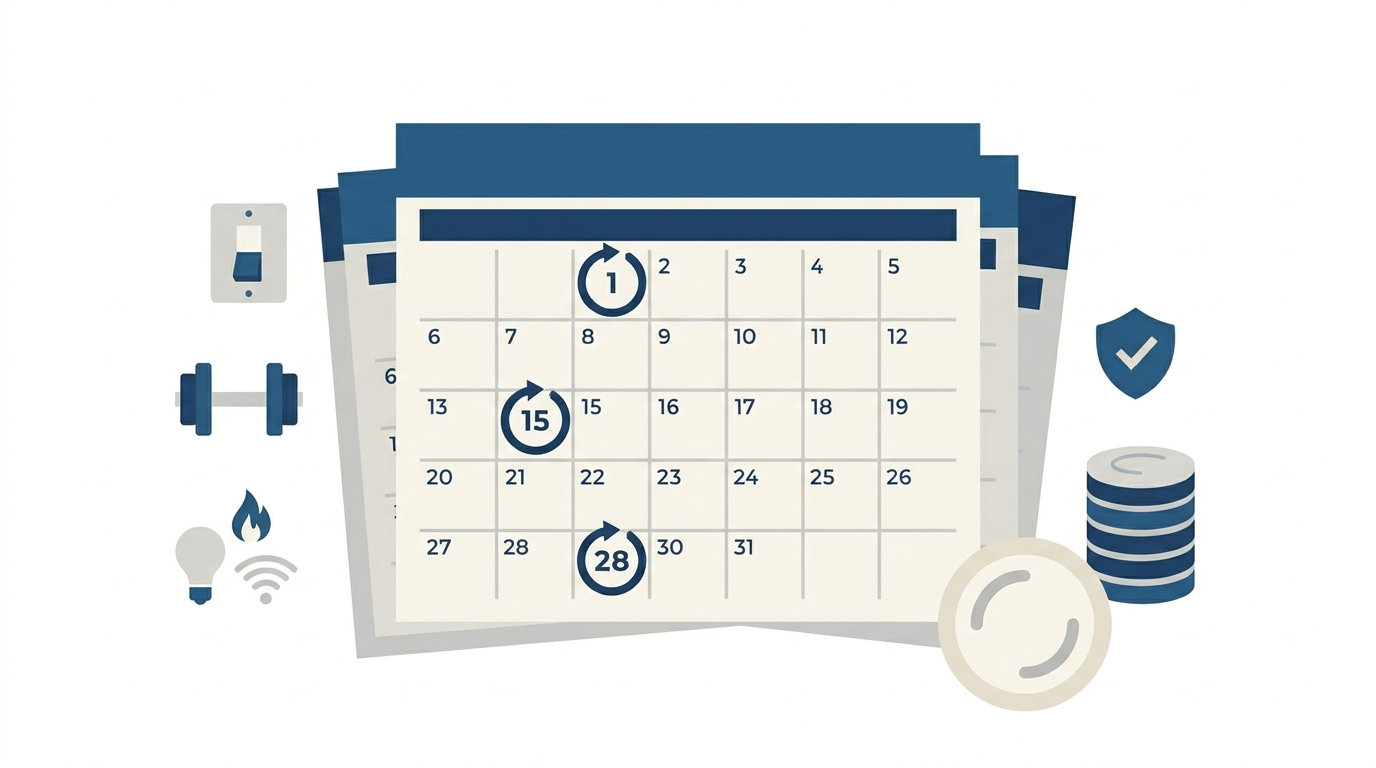
But there’s another category of expenses that most people consistently underestimate: the less visible recurring ones. Home insurance that gets charged once a year. School fees that only apply in September. The car service. The antivirus subscription that renews automatically. The streaming service you no longer use but keep paying for.
Individually, each one seems small or occasional. Together, they can add up to several hundred per month that you weren’t accounting for.
Why recurring expenses are hard to spot
The problem isn’t that they’re hidden. They’re all in your bank statements. The problem is that they don’t happen every month, so when you mentally calculate “how much I spend,” you tend to think about what goes out monthly, not what goes out irregularly.
A home insurance policy costing 480 a year doesn’t feel like a 40-per-month expense. It feels like a 480 hit in October. And if October brings other big expenses, it feels like an exceptional month, not a normal pattern.
This distorts your perception of what your household truly spends. And when your perception is distorted, your financial decisions aren’t as good as they could be.
The recurring expenses most people forget
Here are the recurring costs that most commonly get left out of the calculations:
Annual or semi-annual:
- Insurance (home, car, life, health).
- Property taxes and local levies.
- Vehicle inspections and scheduled maintenance.
- Homeowners’ association fees (special assessments, reserve funds).
- Annual subscription renewals (software, antivirus, cloud storage).
- Professional association or membership dues.
Quarterly:
- Some insurance policies.
- Certain loan or financing payments.
- Medical or dental check-ups.
Irregular but predictable:
- School supplies (September).
- Seasonal clothing.
- Holiday and birthday gifts.
- Vacations.
Those last ones are the most debatable: technically they aren’t “recurring” in the strict sense, but if they happen every year around the same dates, for your financial planning they work exactly the same way.
How to do a complete inventory
The most reliable method is to review your bank statements for the last twelve months – not just the last two or three. With three months, you’ll miss all the annual or semi-annual expenses. With twelve, you’ll catch them all.
For every charge you find, ask yourself:
- Is this an expense that repeats? How often?
- Is it still necessary?
- Is the amount fixed or does it vary?
The goal isn’t to optimize yet. First, you want complete visibility. Many people, doing this exercise for the first time, discover subscriptions they’ve been paying for months or years without realizing, duplicate services, or insurance policies they could get on better terms elsewhere.
Converting it all to a monthly equivalent
Once you have the full inventory, there’s a simple trick to understand what things really cost you: divide every irregular expense by 12 to get its monthly equivalent.
Home insurance at 480 per year -> 40/month. Car inspection and maintenance at 360 per year -> 30/month. Vacations at 1,800 per year -> 150/month.
Add that to your regular monthly expenses, and that figure is your real spending. Not what you spend in any given month, but the average monthly cost your lifestyle actually requires.
The difference between that number and your net income is what you’re truly saving – and what allows you to build a proper emergency fund or, once that’s covered, start investing with a clear plan. Not what you think you’re saving.
What to do with that information
Knowing your real monthly spending figure is useful for three specific things:
1. Plan your cash flow. If you know that October brings home insurance, property tax, and the car service, you can set that money aside starting in August. No surprises.
2. Make better spending decisions. “Can I afford this?” is a question you can only answer well if you know what you truly spend, not what you spend in a quiet month.
3. Identify expenses you can cut. Once you have the complete list, it’s easy to spot services you no longer use, insurance policies that are over-covered, or subscriptions that have become obsolete.
The value of keeping it automated
Doing this exercise once is useful. Keeping it consistently up to date is what truly transforms your household finances.
The problem with maintaining it in a spreadsheet is well known: it works great for the first few months, until a recurring expense changes amount, or you cancel one and add another, and you no longer have time to update all the rows that depend on that data.
When your recurring expenses are defined in a tool that automatically projects them over time, the balance forecast for the coming months updates itself. You don’t need to recalculate anything: you simply check how much money you’ll have in January, or March, or whichever month you need.
In Cuéntamo, every recurring expense you define – with its amount, frequency, and account – automatically generates the projected future transactions. The balance forecast reflects all of that without you having to do anything else. And if an amount changes, you update the recurring entry and the forecasts adjust accordingly.
The simplest starting point
If you’ve never done this exercise and it feels overwhelming, start with just the expenses over 100. Insurance, taxes, large dues. Those alone will already give you a picture quite different from the one you had.
You can add the rest later. What matters is that the snapshot you have of your finances matches reality, not the simplified version your brain constructs to avoid thinking too hard about it.
How does Cuéntamo help with this?
The inventory of recurring expenses you just did on paper is exactly what Cuéntamo keeps for you. Each fixed expense (the rent, the insurance, the subscriptions, the gym membership) is defined once as a recurring item, with its frequency, and from then on it shows up every month without you having to remember it. Those little charges that slip through stop slipping through, because they’re all on the list now.
If you organize them by category, you can see at a glance how much goes to subscriptions, how much to utilities, and how much to insurance, which is exactly where the easy cuts usually are. And if you want to put a ceiling on any of those categories, you can set a budget and check month by month whether you’re sticking to it.
To get started without typing anything, you can import your bank statement (CSV, Excel, or ODS): Cuéntamo reads the transactions, helps you categorize them, and quickly shows you which charges repeat every month. That’s the shortcut for turning this article’s exercise into something that maintains itself. And if you’re also worried about your balance over the coming months, we tie it to the cash flow forecast.
You can try it for free at cuentamo.com.
Frequently asked questions
Why are household recurring expenses so hard to see?
Because not all of them happen every month. A yearly home insurance policy doesn’t feel like a monthly expense, but like a one-off hit in October. That distorts your perception of how much you really spend, even though they’re all in your bank statement.
How do I make a complete inventory of my recurring expenses?
Review your bank statements for the last twelve months, not just the last two or three. With twelve months you also catch every annual and semi-annual expense that a shorter period would miss.
How do I work out the real monthly cost of something I pay once a year?
Divide the annual amount by 12 to get its monthly equivalent. A 480-per-year insurance policy is 40 a month. Adding that equivalent to your usual monthly expenses gives you your real spending, not that of a quiet month.
Where do I start if I’ve never done this and it feels overwhelming?
Start with just the expenses over 100: insurance, taxes, and large dues. Those alone will already give you a picture quite different from the one you had. You can add the rest later.
This article is checked against official sources and reviewed periodically. If you spot anything out of date, email us at [email protected].