Input VAT vs Output VAT: the difference, with a worked example (Spain)
If you’ve just registered as an autónomo (self-employed worker), or you’ve only been one for a short while, there are two terms that come up constantly and that are worth understanding well from the start: IVA soportado (input VAT) and IVA repercutido (output VAT).
They’re not difficult concepts. They’re difficult to understand when they’re explained in technical language before they have any context. With a concrete example, they fall into place on their own.
Input VAT vs output VAT at a glance
| Output VAT (IVA repercutido) | Input VAT (IVA soportado) | |
|---|---|---|
| What it is | The VAT you add to the invoices you issue | The VAT you pay on invoices from your suppliers |
| Who bears it | Your client | You, on paper (then you deduct it) |
| For the tax agency it is | A debt: you collect it on the State’s behalf | A credit: you subtract it from what you owe |
| Example | 2,000 € invoice + 21% = 420 € | 200 € software + 21% = 42 € |
Worked example for one quarter: output VAT 420 € − input VAT 42 € = 378 € to pay. If the input VAT had been 500 € instead, the result would be −80 €: a balance in your favour to offset later or get refunded.
The autónomo’s role in the VAT system
VAT (Impuesto sobre el Valor Añadido, value-added tax) taxes consumption. It’s ultimately paid by the final consumer. But it doesn’t reach the Spanish Tax Agency (Agencia Tributaria) directly from the consumer: it arrives through all the links in the chain of production and sale.
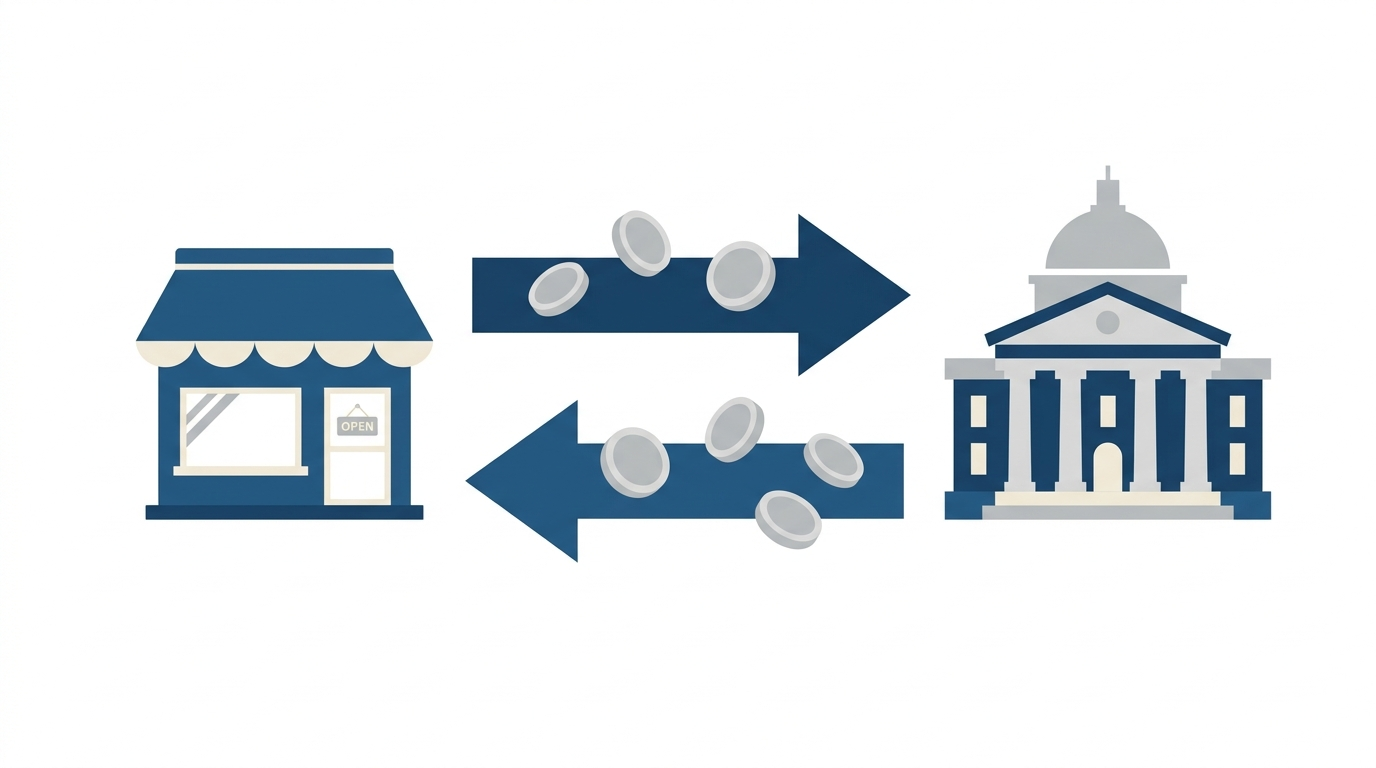
As an autónomo, you’re one of those links. Your role in the VAT system is twofold: you collect VAT from your clients, and you pay VAT to your suppliers. The difference between what you collect and what you pay is what you pay over to the Agencia Tributaria.
That’s all. Everything else is detail.
Output VAT: the one you charge
When you issue an invoice to a client, you add the corresponding VAT to the amount of your service or product. That VAT shown on your invoice is called output VAT (IVA repercutido).
Example: you invoice a design project for 2,000 euros. You add 21% VAT (the general rate in force in 2026): 420 euros. Your client pays you 2,420 euros in total.
Of those 2,420 euros, 420 aren’t yours. They belong to the State. You’ve collected them on its behalf and you’ll have to pay them over to the Agencia Tributaria in the next quarterly return.
Output VAT is, therefore, a debt to the Agencia Tributaria. It isn’t income of yours, even though it passes through your bank account.
Input VAT: the one you pay
When you pay a supplier’s invoice for an expense related to your activity, that invoice also carries VAT. The VAT you pay is called input VAT (IVA soportado).
Example: you buy design software for 200 euros plus 42 euros of VAT. You pay 242 euros in total.
Those 42 euros of VAT you’ve paid are deductible: you can subtract them from the VAT you owe the Agencia Tributaria. You don’t recover them directly, but they reduce what you have to pay.
Input VAT is, therefore, a credit against the Agencia Tributaria.
The quarterly settlement: the difference between the two
Each quarter, you do the sum:
VAT to pay = output VAT − input VAT
If the result is positive, you pay that amount to the Agencia Tributaria. If it’s negative, meaning you’ve paid more VAT than you’ve collected, you have a balance in your favour that you can offset in the following quarter or request to be refunded at the end of the year.
This calculation assumes you’ve already collected what you invoiced. If your clients pay late, you can end up paying VAT in a quarter you haven’t actually received yet; there’s a scheme designed for that, cash-basis VAT (RECC), though it doesn’t always pay off.
Continuing with the previous example:
- Output VAT in the quarter: 420 euros (the design-project invoice).
- Input VAT in the quarter: 42 euros (the software) + other expenses with VAT.
- Amount to pay: 420 − 42 − the rest of the input VAT.
The more input VAT you have (the more professional expenses with VAT you’ve paid), the less you pay to the Agencia Tributaria. Hence the importance of keeping every expense invoice and recording it correctly.
Which input VAT is deductible and which isn’t
Not all the VAT you pay is deductible. Only the VAT on expenses directly related to your economic activity.
The VAT on office supplies: deductible. The VAT on the subscription to the software you use for work: deductible. The VAT on the supermarket shop: not deductible.
The most contentious cases are mixed expenses: the mobile phone you use for both work and personal life, the car, the computer your family also uses. And here comes a rule that surprises a lot of people, because VAT works differently from income tax: for VAT, a mixed-use item is not deducted by halves — it is not deducted at all. The law requires “direct and exclusive” affectation, and expressly says that goods or services “used simultaneously for business or professional activities and for private needs” are not affected.1 That is why the VAT on a phone line you share with your personal life is not deductible in any proportion.
The law itself opens two exceptions, and only two. Investment goods do allow a proportional deduction, based on their foreseeable use in the activity.2 And among them, passenger cars carry a statutory presumption of 50%, extended to fuel, repairs, tolls and parking.3 We go into it in how far the deduction goes on the car, the phone and the home.
A general rule that helps avoid problems: if you don’t have a complete invoice with your tax details, the VAT on that expense isn’t deductible. A cash-register receipt with no NIF (tax ID number) won’t do. A simplified invoice without your details won’t either. The useful twist: you can ask for your tax number and the VAT stated separately while you’re paying, and then it does deduct (how and when that works).
VAT on invoices to clients outside Spain
If you invoice clients in other European Union countries or outside it, the rules change.
With a client outside the EU there is a confusion worth clearing up, because it changes what you write on the invoice. If you sell goods that leave the Community, that is an export and it is exempt. If you sell services, the question is not whether they are exempt but where the service is deemed to be supplied, and that depends on who your client is. If it is a business or a professional, the service is located where they are, so it falls outside Spanish VAT. If it is a private individual, the general rule is the opposite, it is located where you are, and only certain services (consultancy, advisory, advertising, translation, legal services and a few more) are excluded when the client is outside the Community. There are also special rules depending on the type of service.4 The invoice may end up without VAT in both cases, but not for the same reason. You still file the modelo 303 (the quarterly VAT return), with zero output VAT on those operations.
Operations with EU clients that are companies or self-employed have their own regime: the reverse charge (inversión del sujeto pasivo). In these cases, you don’t charge VAT on the invoice and the client declares the VAT in their own country.
If you have clients outside Spain, this is an area where it’s worth at least consulting an accountant the first time, to make sure you’re applying the right regime.
Why it’s important not to mix VAT with your income
Output VAT passes through your bank account, but it isn’t yours. This is a common misperception, especially in the first months as an autónomo.
If you invoice 2,420 euros (2,000 base plus 420 VAT), your real income is 2,000 euros. The 420 are a temporary deposit from the State in your account. When the quarter comes, you’ll have to give them back.
If you make spending decisions assuming you have 2,420 euros available, on the day of the return you’ll run into a problem. It’s not unusual for autónomos with only a few months of activity to reach the quarter without enough liquidity to pay the VAT for exactly this reason.
The solution is mental before it’s technical: every time you collect an invoice, set aside (mentally, or physically, in a separate account) the VAT that isn’t yours. When the quarter comes, that money is already reserved.
A three-line summary
- Output VAT (IVA repercutido): the one you charge your clients. It isn’t yours, you owe it to the Agencia Tributaria.
- Input VAT (IVA soportado): the one you pay your suppliers for professional expenses. It reduces what you owe.
- Quarterly amount: the difference between the two. If it’s positive, you pay it. If it’s negative, you offset it or get it refunded.
With that clear, the modelo 303 stops being a mysterious form and becomes what it is: a subtraction with a few extra details. If you want to see your result instantly, try the quarterly VAT calculator.
How does Cuéntamo help with this?
All this separation between the VAT you charge and the VAT you pay is exactly what Cuéntamo’s freelance module keeps track of for you. When you record an issued invoice, its output VAT goes on one side; when you record a professional expense, its input VAT goes on the other. The quarter’s amount, the subtraction of the two we saw above, comes out on its own, broken down by VAT rate, without you adding up two columns of a notebook by hand.
That helps directly with the idea of not mixing VAT with your income: because output and input VAT are identified from the very first entry, you always know how much of your balance is really yours and how much is money you’ll have to hand over. And if in a given quarter the input VAT exceeds the output VAT, that balance in your favor carries forward to offset in the following quarters instead of being lost.
To get started without entering invoice by invoice, you can import your bank statement and let Cuéntamo help you classify the transactions. The next step, once both sides are clear, is to calculate the quarterly VAT and file the modelo 303.
The freelance module is part of Cuéntamo Más. You can get started at cuentamo.com.
Frequently asked questions
What’s the difference between input and output VAT?
Output VAT is the one you charge your clients when you issue an invoice; it isn’t yours, you owe it to the Agencia Tributaria. Input VAT is the one you pay your suppliers on business expenses, and it reduces what you have to pay over.
Is the VAT I charge my clients mine?
No. Even though it passes through your bank account, output VAT belongs to the State: you collect it on its behalf and pay it over each quarter. If you invoice 2,000 euros plus VAT, your real income is 2,000 euros; the VAT is a temporary deposit you’ll have to return.
Is all the VAT I pay deductible?
No. Only the VAT on expenses directly related to your economic activity and with a complete invoice in your name. The VAT on office supplies or work software is deductible; the supermarket shop is not. A receipt without your tax details doesn’t give you the right to deduct either.
How is the quarterly VAT amount calculated?
It’s a subtraction: output VAT minus input VAT. If the result is positive, you pay it to the Agencia Tributaria; if it’s negative, you offset it in the following quarter or request a refund at the end of the year.
What happens with VAT if I invoice clients outside Spain?
The rules change. If you sell goods that leave the Community, that is an exempt export. If you sell services, what decides is not an exemption but where the service is deemed to be supplied, and that depends on whether your client is a business or a private individual. Operations with EU companies or freelancers fall under the reverse charge (invoices without VAT, with the client declaring it in their own country). It’s worth consulting an accountant the first time.
Figures for 2026. The general VAT rate of 21% has been in force since 2012 (RDL 20/2012).
This article is checked against official sources and reviewed periodically. If you spot anything out of date, email us at [email protected].
Article 95, paragraphs One and Two, of Law 37/1992, on VAT. Paragraph One bars deducting input tax on goods or services “not directly and exclusively” used for the activity; paragraph Two.2 specifies that goods or services “used simultaneously for business or professional activities and for private needs” are not treated as affected. Income tax follows a different logic, hence the confusion: there, partial affectation of what is divisible is possible (article 29.2 of the Income Tax Act). Spanish-language sources. ↩︎
Article 95.Three, rule 1ª, of the VAT Act: input tax on investment goods used “wholly or in part” in the activity is deducted “to the extent that those goods are foreseeably to be used, on well-founded criteria”. The deduction is adjusted if actual use turns out different (rule 3ª), and the degree of use must be provable by any means of evidence (rule 4ª). ↩︎
Article 95.Three, rule 2ª, of the VAT Act: passenger cars “shall be presumed to be used for the business activity in a proportion of 50 per cent”. Article 95.Four extends the rule to accessories and spare parts, fuel, parking and tolls, and repairs. Vehicle insurance falls outside because insurance transactions are VAT-exempt (article 20.One.16): there is no input VAT to reclaim. ↩︎
The exemption for exports is in article 21 of Law 37/1992, on VAT, whose heading reads, literally, “Exemptions on exports of goods”. Services do not go through that article but through the place-of-supply rules: article 69, “Place of supply of services. General rules”, and article 70, “Special rules”. The Spanish tax agency states the general rule as follows: where the recipient is a business or professional, the service is located “where the seat of their economic activity lies”; where the recipient is not, “where the seat of the supplier’s economic activity lies” (Supply of services — VAT on foreign trade operations). Spanish-language sources. ↩︎