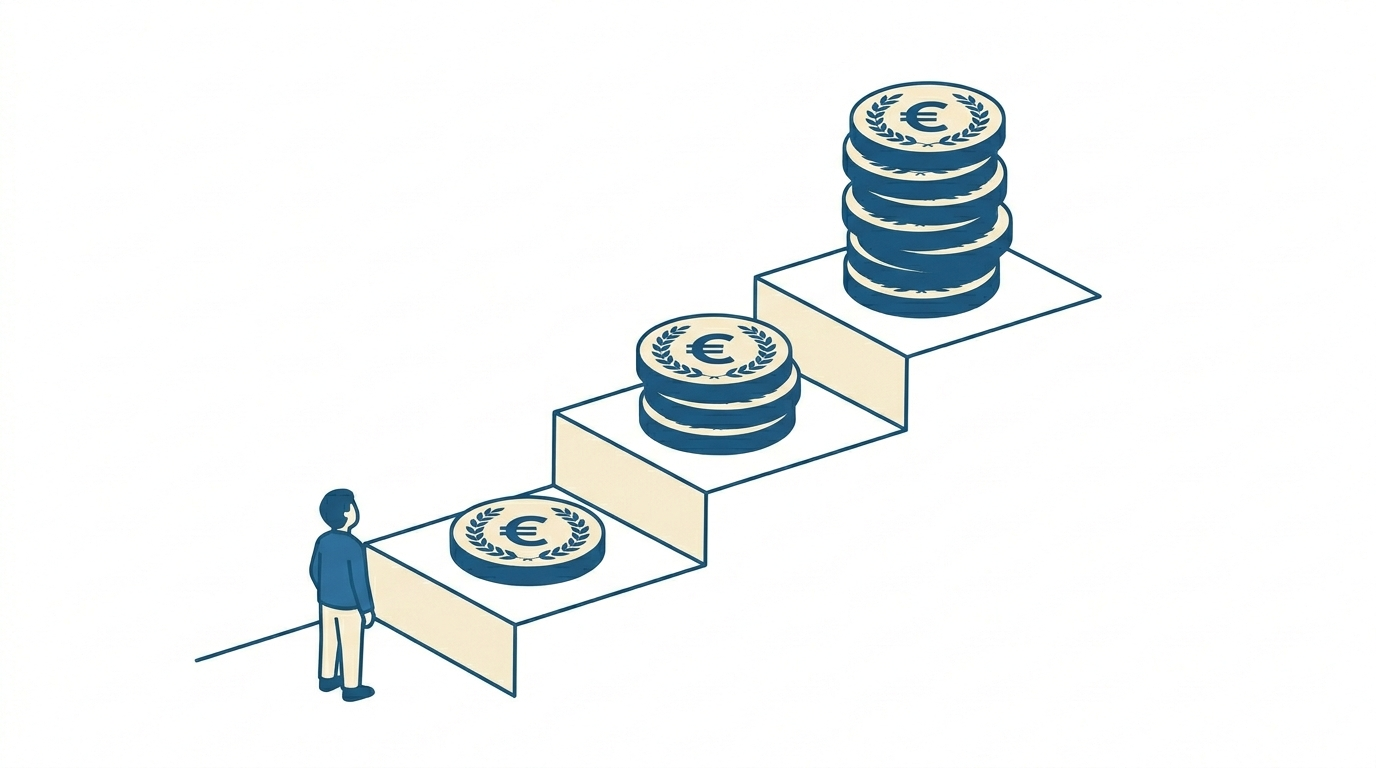
From 80 to 400 euros a month: how to prepare your finances for when the tarifa plana ends
When you registered as an autónomo (self-employed worker), the tarifa plana (the reduced flat-rate Social Security contribution for new freelancers) was probably the best news in the whole process. Eighty euros a month for your Social Security contribution. Nothing. A huge relief in the first few months, when income is still on its way and every euro counts.
The problem is what comes afterwards. Because the tarifa plana ends. And when it ends, it doesn’t go up a little: it multiplies by four or five all at once. And it coincides precisely with the moment when many autónomos start to have real income, so the blow gets mixed up with the first sizeable quarterly IVA (VAT) and IRPF (personal income tax) payments.
If you’re on the tarifa plana right now, this article is to help you prepare. If yours ends in two months, you might just make it in time.
How the current tarifa plana works
Since 2023, the tarifa plana for new autónomos works like this:
Months 1 to 12: contribution of 80 euros/month. It doesn’t matter how much you bill. It’s a fixed 80 euros.
Months 13 to 24: contribution of 80 euros/month if your net earnings don’t exceed the Salario Mínimo Interprofesional (SMI, the national minimum wage). If they exceed it, you move straight to the system of contribution by real income and you’re assigned the corresponding bracket.
From month 25 onwards: the system of contribution by real income for everyone, no exceptions.
In other words, if your business goes well and you exceed the SMI in net earnings, the tarifa plana lasts 12 months. If you don’t exceed it, it can stretch to 24. But at some point it ends. And the contribution you start paying isn’t just an expense: it sets your future benefits. If you want to see what you get in return —how much you’d receive on sick leave or as a future pension based on your base— our sick leave and pension calculator for the self-employed breaks it down.
The real numbers of the transition
This is where many autónomos get the fright. Let’s put some concrete numbers.
Situation during the tarifa plana:
- Average monthly billing: 2,500 euros
- Self-employed contribution: 80 euros
- Monthly deductible expenses: 400 euros
- Money available after contribution and expenses: 2,020 euros
Situation after the tarifa plana (net earnings 2,100 euros/month, corresponding bracket):
- Average monthly billing: 2,500 euros (same)
- Self-employed contribution: 401 euros (bracket of 2,030-2,330 euros of net earnings, 2026 contribution)
- Monthly deductible expenses: 400 euros (same)
- Money available after contribution and expenses: 1,699 euros
The difference: 321 euros less a month in your pocket. Over the year that’s 3,852 euros. And that’s assuming your billing stays stable, which doesn’t always happen in the first few months after the tarifa plana.
The cascade effect
But the contribution isn’t the only thing that changes. When the tarifa plana ends, it usually coincides with other changes:
First or second full year of activity, which means the quarterly returns start to show higher figures. If in the first quarter you paid little IRPF because you billed little, now that you bill more the modelo 130 (the quarterly income tax return) also goes up.
End of the “novelty” effect, where your first clients have already stabilised and you need to keep prospecting in order to grow. Just when you most need to invest in marketing or tools, the contribution rises.
Possible contribution adjustment from the previous year, if you contributed at the minimum during the tarifa plana but your real earnings were higher. The contribution adjustment can arrive right in this transition.
Exactly when your tarifa plana ends
The exact date depends on when you registered. If you registered on 15 March 2025, your 80-euro tarifa plana lasts at least until 14 March 2026 (12 months). If your net earnings don’t exceed the SMI, it extends until 14 March 2027 (24 months).
The specific day matters because the new contribution is applied to the full month following the end of the tarifa plana. If your tarifa plana ends on 14 March, in April you’re already paying the full contribution.
Note down the date. Put it in the calendar with an alarm three months before. Those three months are your window to prepare.
Action plan: the three months before
Month -3: calculate your real bracket
Log in to the Social Security’s Import@ss portal and check which bracket you’d fall into according to your current net earnings. The calculation is:
Net earnings = (Annual income - Deductible expenses - Contribution paid) / 12
Apply the generic 7% deduction on that result. The final figure is your monthly net earnings for choosing a bracket.
If you’re not clear on what your deductible expenses are, it’s a good time to review them. Every expense you can justify reduces your net earnings and therefore your future contribution.
Month -2: adjust your expense forecast
You already know what your new contribution will be. Now incorporate it into your monthly planning. Not just as an abstract number, but as a real recurring expense that you’ll pay every month from date X.
Look at how your monthly cash flow turns out with the new contribution. If the difference leaves you tight, it’s time to look for more income or cut expenses before the change arrives.
Month -1: build the buffer
The new contribution doesn’t come alone. It comes accompanied by a quarter of taxes that will probably be higher than the previous ones (because you’ve been billing at a good pace for more months). The month before the change, make sure you have at least two months of the new contribution in reserve, plus the estimate for the next quarter.
For an autónomo going from 80 to 401 euros of contribution, that means having at least 802 euros of extra buffer just for contributions, plus whatever corresponds to quarterly IVA and IRPF.
How to build the buffer during the tarifa plana
The months of the tarifa plana are the months when it’s easiest to save, because your tax burden is minimal. Make the most of them.
Simple rule: each month set aside the difference between what you pay (80 euros) and what you’d pay without the tarifa plana (your estimated real bracket). In the example above that difference is around 321 euros a month; set them aside in a separate account.
After 12 months doing this, you’ll have around 3,852 euros of buffer: a whole year of the contribution difference (321 euros/month in this example). In other words, almost a whole year to get used to the new expense without feeling the blow.
| Month | Real contribution | Estimated future contribution | Monthly saving | Accumulated |
|---|---|---|---|---|
| 1 | 80 | 401 | 321 | 321 |
| 2 | 80 | 401 | 321 | 642 |
| 3 | 80 | 401 | 321 | 963 |
| 6 | 80 | 401 | 321 | 1,926 |
| 9 | 80 | 401 | 321 | 2,889 |
| 12 | 80 | 401 | 321 | 3,852 |
If you start saving from the first month of the tarifa plana, when it ends you’ll have a buffer equivalent to a year of the difference. That’s a lot of margin.
The mistake of doing nothing
The most common mistake is not thinking about the transition until it arrives. One day you check the account and the contribution was 401 instead of 80. Without warning (well, the warning was registering knowing the tarifa plana was temporary). Without preparation. And that month the account comes up shorter than usual.
If on top of that the month coincides with a quarterly IVA or IRPF payment, the blow is double. And if a client also pays you late, the month turns into a full-blown cash-flow crisis.
None of this is inevitable. It’s just a matter of planning it in advance.
The psychological trap of the tarifa plana
The tarifa plana is a poisoned gift in a very specific way: it gets you used to a level of fixed expenses that isn’t real. Your first twelve months as an autónomo have an artificially low fixed cost. You make decisions (renting a space, contracting a tool, setting your rates) based on a temporary cost structure.
When the contribution rises, your rates should rise too. But many autónomos forget to recalculate. They set an hourly price back then thinking “with an 80-euro contribution it works out fine for me”, and now with 401 it doesn’t work out so well. But changing rates for existing clients is a hassle.
Review your rates at the same time as you plan the transition. If you need to charge 10-15% more to keep your margin, it’s better to start communicating it now than to wait until you’re already drowning.
Alternatives if you can’t make it
If the new contribution leaves you in a very tight situation, there are a few options:
Contribute at the minimum bracket of your range. Within each bracket there’s a minimum and a maximum. If you can justify that your earnings are at the lower end of the bracket, contribute at the minimum base.
Review deductible expenses. Every euro of legitimate deductible expense you add reduces your net earnings and can lower your bracket. Don’t invent expenses, but make sure you’re not leaving any out. Home utilities (deductible percentage), equipment depreciation, professional fees… it all adds up.
Change bracket if your income drops. You can modify your contribution base up to six times a year. If a quarter goes badly, lower the bracket. There’s no need to wait for the adjustment to make changes.
How does Cuéntamo help with this?
The end of the tarifa plana won’t catch you off guard if you see it coming months ahead, and that’s exactly what Cuéntamo lets you do. You set up your freelancer fee as a recurring transaction: once you know the new contribution you’ll be charged, you update the amount and the date it kicks in, and every future month recalculates on its own.
With that in place, the cash-flow forecast shows you the jump. Instead of discovering the higher charge the day it hits your bank, you see on the balance chart how your account evolves over the coming months with the new fee already included. If that step leaves you in the red at some point, you know it today and have room to react.
Setting aside the buffer is also easier when you can see it. You can create a separate account for it, record the monthly contribution as a recurring transaction and track its growth alongside the rest of your accounts. The idea of saving the tarifa plana discount stops being a good intention and becomes a number you watch grow each month.
You can try it in Cuéntamo.
Frequently asked questions
How long does the self-employed tarifa plana last?
The reduced contribution covers the first twelve months. It can be extended for twelve more months if your net earnings don’t exceed the Salario Mínimo Interprofesional (national minimum wage); if they exceed it, you move earlier to the system of contribution by real income.
How much does the contribution rise when the tarifa plana ends?
It doesn’t rise a little: it multiplies by four or five all at once, because you move to contributing according to the bracket that applies to you based on your real net earnings. The exact jump depends on how much you earn.
When exactly does my tarifa plana end?
The date depends on the day you registered: the full contribution applies to the full month following the end of the tarifa plana. It’s worth noting it in the calendar with an alarm three months before to have room to prepare.
How do I prepare for the contribution jump?
During the tarifa plana months, set aside each month the difference between what you pay and what you’d pay without it, in a separate account. That way, when the change arrives, you’ll have a buffer to acclimatise without feeling the blow.
Can I lower the bracket if the new contribution is choking me?
You can modify your contribution base up to six times a year. If a quarter goes badly, you lower the bracket without waiting for the adjustment; reviewing your deductible expenses carefully can also help you drop down a bracket.
Set up in Cuéntamo a recurring expense with the new contribution from the month it applies. Your forecast will show you whether you need to adjust anything before the change arrives. And if you’re on the tarifa plana now, the 24-month forecast shows you exactly where the cliff edge is. Available at cuentamo.com.
Figures for 2026. Self-employed contributions and contribution brackets are revised each year; check the amounts in force for your tax year.
This article is checked against official sources and reviewed periodically. If you spot anything out of date, email us at [email protected].