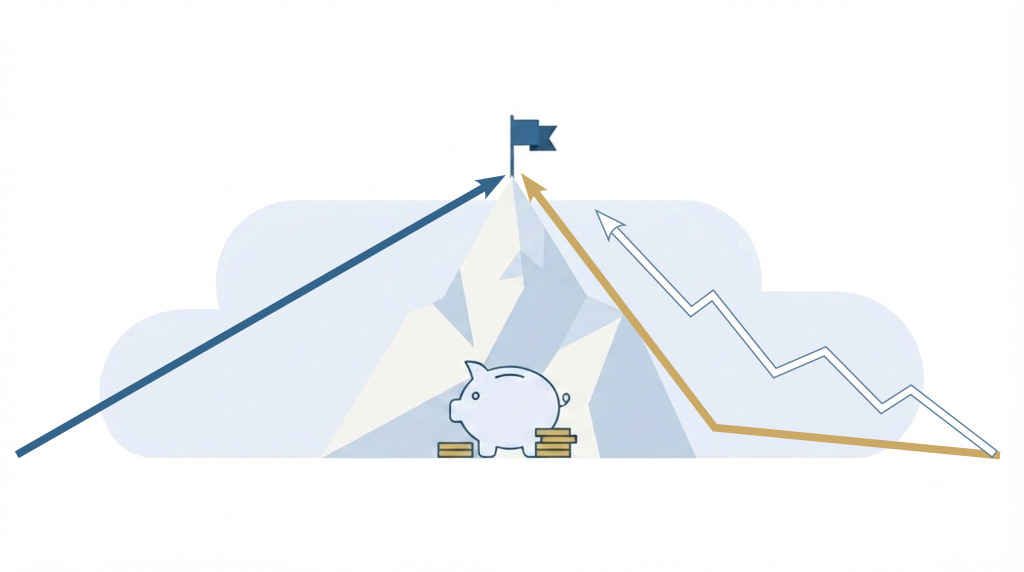
How to maximise your self-employed pension: contribute the maximum, or invest the difference?
As an autónomo (self-employed worker) you get to choose (within limits) how much you contribute each month. And that raises a question almost nobody answers with real numbers: is it better to push hard and contribute on a high base from now to collect a bigger pension, or to contribute the minimum, invest what I save, and raise my base only at the end?
This isn’t a matter of faith. It depends on how the pension is calculated, and once you understand that mechanism you discover something that changes the whole strategy: most of your contributing life doesn’t count towards the amount of your pension. Let’s see why, and at the end we’ll show you a free calculator to test it with your own figures.
Your pension is two things multiplied
The retirement pension of a self-employed worker is calculated exactly like an employee’s. It’s two pieces multiplied together:
- The regulatory base (base reguladora): an average of your contribution bases over the final years.
- A percentage that depends on the total number of years you’ve contributed.
The result is capped at the top (the maximum pension in 2026 is 3,359.60 euros a month) and at the bottom (the minimum pension), and it’s paid in 14 instalments a year. The key is that each piece looks at something different, and only one of them cares about how much you contribute.
The percentage depends on years, not on how much you pay
The first piece, the percentage, only looks at how many years you’ve contributed, not on which base. With 15 years contributed (the minimum to qualify) you get 50% of the regulatory base, and that percentage rises with each month contributed up to 100%, reached in 2026 at 36 years and 6 months (37 years from 2027).
The important part: a year contributing on the minimum base counts towards that percentage exactly the same as a year on the maximum. To reach 100% it makes no difference whether you paid the minimum contribution (about 206 euros a month in 2026) or the maximum (about 1,607 euros). Years count, not euros.
The regulatory base only looks at the final years
The second piece, the regulatory base, is where how much you contribute does matter. But (and here’s the interesting bit) it doesn’t look at your whole working life, only the final stretch.
In 2026 the formula adds up your contribution bases over the last 25 years (the last 300 monthly bases) and divides them by 350. The 2023 reform added an alternative formula that widens that window slightly (up to about 29 years when fully phased in) and lets you discard the worst months, applying whichever is more favourable. Either way, we’re talking about the last 25 to 29 years before you retire.
What about what you contributed before that window? It doesn’t count towards the regulatory base. Contributing on a high base at 30, if you retire at 67, is money that improves your percentage (because it adds years) but not your regulatory base. And you already have that percentage covered by contributing the minimum.
The upshot: contributing high only counts at the end
Put the two ideas together and the trick appears: contributing on a high base only moves your pension when you do it inside that final window of 25 to 29 years. Before that window, raising your base is effort that doesn’t turn into more pension (it only adds years, which you already add by paying the minimum).
With one caveat worth not overstating: contributing the maximum for the last two months does nothing (that’s 2 monthly figures out of 300). The effect grows with how many years of that window you contribute high on. A couple of years is barely noticeable; contributing the maximum for the last five, ten or fifteen years does raise the regulatory base clearly.
That opens up a possibility many people never consider: contribute the minimum during the early years, invest what you save yourself, and use that money to contribute the maximum right in the final stretch, which is the one that counts.
So: raise your base now, or invest and raise it at the end?
Let’s frame it as two strategies with the same monthly outlay (the most you can afford to put towards contributions):
- Strategy A (raise your base now): you raise your contribution base from now up to what your budget allows and keep it until you retire.
- Strategy B (minimum + invest + maximum at the end): you contribute the minimum, invest the difference each month in an index fund, and in the final years you drain that fund (what you put in plus the returns) to contribute at the maximum your income allows.
Which leaves you a bigger monthly pension? There’s no single answer: it depends on your age, your history, how much you can afford and the return you expect from the fund. That’s why we built a free self-employed sick-leave and retirement calculator that compares the two strategies with your figures and tells you how many final years at the maximum the fund finances and what pension each path leaves you.
A worked example (illustrative)
Picture a self-employed worker with about 20 years left to retirement, who can afford to contribute on a base of 1,500 euros a month, whose income would let them reach the maximum base (5,101.20 euros in 2026), and who estimates a real return of 4% a year on their fund (already net of inflation).
- Strategy A: contributes on a 1,500 base for the 20 years. Ends up with a pension of around 1,244 euros a month.
- Strategy B: contributes the minimum and invests the difference; the accumulated fund finances contributing the maximum for about 5 years at the end. Ends up with a pension of around 1,442 euros a month.
With the same financial effort, concentrating the high contribution in the final stretch leaves them almost 200 euros more pension a month, for life. Why? Because those years on a 5,101 base inside the window pull the average up much more than a steady 1,500 base. (The figures are illustrative; the result changes with your case, and cashing out the fund is taxed under the savings scale, from 19% to 28%.)
What the numbers don’t tell you (and also decides)
Before you jump in, consider what a pension calculation doesn’t reflect:
- The pension is guaranteed money and rises with inflation (IPC). The index fund carries market risk: that 4% is an assumption, not a promise. You’re comparing something certain with something expected.
- But don’t take the pension for granted. The public system is pay-as-you-go: today’s workers’ contributions pay today’s pensions. With an ageing population and the largest generations retiring, that balance is under strain, and the State has spent years propping it up with transfers from the general budget (Presupuestos Generales); some already describe it as a broken system kept afloat only with public money. On top of that, the rules (age, calculation period, revaluation) are reformed every few years. The pension is guaranteed by law, but its future amount depends on political decisions you don’t control: a different kind of risk from the market’s, and one more reason not to bet everything on contributions and to diversify with your own savings.
- Contributing more improves more than retirement. It also raises your sick-leave benefit, your cessation-of-activity benefit and the survivor’s pension for your family. If you contribute the minimum for many years, you give up that protection along the way.
- You can’t contribute below your means. Under the real-income contribution system, your bracket sets a minimum base based on what you earn: if you bill well, you won’t be able to contribute on the absolute minimum base.
- Retiring early is penalised. If you retire before the ordinary age, reduction coefficients apply that lower the pension for life, so the final stretch is also about when, not only how much.
How to see it with your figures
The theory is clear; what decides is your specific case. Two steps:
- Download your contribution-base report from the Social Security Import@ss portal: it gives you the base for each period of your working life.
- Put it into the sick-leave and retirement calculator, try the two strategies and see which leaves you a bigger pension.
How Cuéntamo helps
The play only works if you keep two things going all year: knowing which base suits you, and the discipline to actually invest the difference (rather than spend it). That’s exactly what Cuéntamo makes easy:
- You know which base you’re on and which you can afford. With your income and expenses up to date you see your net earnings, which is what sets your bracket. And you can change bracket up to six times a year (we cover it in the contribution adjustment guide).
- You know how much you can set aside. The balance forecast tells you how much to invest in the fund each month without running short on cash flow, and flags when the contribution rises if you move up a bracket.
- You keep it all in one place. The self-employed module keeps your contributions and taxes under control, and the investments and net-worth module lets you track that index fund financing the maximum contribution in the final stretch.
You know what you contribute and what you save, which is the first step to knowing what you’ll collect. You can try it free at cuentamo.com and see everything it offers for the self-employed.
Frequently asked questions
Does contributing on the minimum base my whole life leave me without a pension?
Not without a pension, but with a low one. You’ll be entitled to it if you’ve contributed at least 15 years, and the percentage for years contributed is the same as contributing high. What drops is the regulatory base, because the average of your final bases will be small. Contributing high in the final years is what raises that average.
How many years count towards the pension’s regulatory base?
In 2026 the bases from the last 25 years are used (300 months divided by 350). The 2023 reform added a formula that widens the window to about 29 years discarding the worst months, and the more favourable one applies. What you contributed before that window doesn’t affect the amount.
Is it legal to contribute the minimum and raise the base only at the end?
Yes, always within what your real-income bracket allows. You can change your contribution base up to six times a year through Import@ss, with no penalty. The only condition is not to contribute below the minimum that corresponds to your net earnings.
Is it better to invest in a fund than to contribute more?
It depends on the return you expect, the years you have left and how much you can contribute. In many cases, investing the difference and contributing the maximum only in the final stretch leaves a bigger monthly pension for the same outlay. But remember the pension is, at least in theory, safe and has been revalued through successive laws in recent years, while the fund carries risk. Compare it with your figures in the retirement calculator.
Does contributing more improve anything besides retirement?
Yes. The base you contribute on also determines your sick-leave benefit, your cessation-of-activity benefit and the survivor’s pension. Contributing the minimum for many years makes the payment cheaper, but reduces that protection in the meantime, something worth weighing before cutting it fine.
Cuéntamo is an accounting app for the self-employed and households that helps you know what you contribute, what you can afford and how your balance forecast looks. You can try it free at cuentamo.com.
Figures for 2026. The regulatory base and its calculation period are set out in article 209 of the General Social Security Act, as reformed by Royal Decree-law 2/2023; the percentage scale and retirement ages, in Law 27/2011; the 2026 contribution bases and rate, in Order PJC/297/2026; the 2026 minimum and maximum pensions, in Royal Decree 241/2026. Bases, contributions and pensions are revised each tax year.
This article is checked against official sources and reviewed periodically. If you spot anything out of date, email us at [email protected].