Compound interest explained with real examples: the snowball of savings
Imagine two people. The first starts saving and investing early, with modest amounts, doing so consistently over many years. The second waits longer, saves twice as much each month, but only for half the period. In the end, the first person accumulates more, even though they contributed far less money in total.
That result seems counter-intuitive. How can someone who puts in less end up with more? The answer is compound interest: the mechanism that makes time, not the amount, the most valuable financial asset of all.
What is compound interest?
When you deposit money in an account or invest it in a fund, that money generates a return. If you reinvest that return (instead of withdrawing it), the next period generates a return on the original capital plus the return you already earned before.
In other words: the money your money earns also earns money.
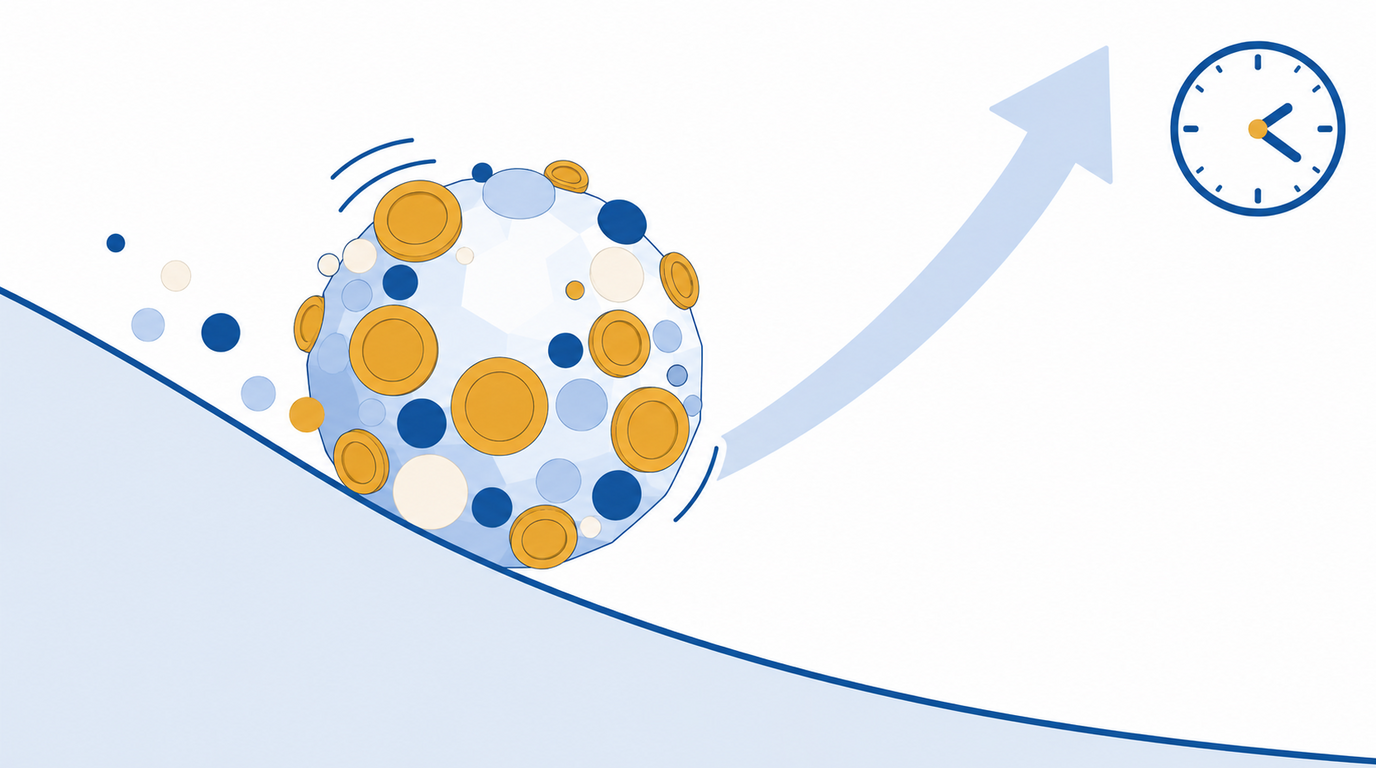
At first it seems insignificant. One month, a small difference. One year, something more noticeable. But as time passes, the effect accelerates exponentially. Think of a snowball rolling down a long slope: the further it rolls, the bigger it gets; the bigger it is, the more surface it has to collect more snow.
The basic formula is:
Final capital = Initial capital × (1 + annual return)^number of years
You don’t need to memorize the formula. What matters is understanding what the exponent (the number of years) implies. Unlike simple interest, where the return is always calculated on the initial capital, compound interest is calculated on a capital that grows each year.
The example of 100 euros per month
Let’s put in concrete numbers. Assume an annual return of 7%, a conservative estimate of what global markets have historically delivered over the long term. These are illustrative figures: past returns don’t guarantee future ones, and no single real year behaves like the average.
Person A invests 100 euros per month for 30 years. Total contributed: 36,000 euros.
Person B invests 200 euros per month, but only for 15 years. Total contributed: 36,000 euros.
Both contribute exactly the same amount. The difference is time.
At the end of their respective horizons, Person A accumulates around 120,000 euros. Person B accumulates around 65,000 euros.
Person A ends up with almost double, with the same total contributions. The reason: their investments have been growing and generating returns for twice as long. The final years are the ones that weigh most: when the capital is already large, even a 7% annual return represents an enormous sum in absolute terms.
Time versus amount: the most important lesson
This example illustrates the key principle of compound interest: time contributes more than amount.
That doesn’t mean saving more is bad (more capital always helps, clearly). It means that if you have to choose between starting early with little or waiting to start with more, it’s almost always better to start early.
Look at it another way. A person who starts investing 150 euros a month from age 25, at the same historical 7% return, accumulates approximately 370,000 euros by age 65, with a total contribution of 72,000.
If that same person had waited ten years and started at 35, they would need to invest more than 300 euros per month to reach the same final result at 65. In other words: a decade of delay doubles the monthly effort required.
Every year that passes without investing isn’t a year where “nothing happened.” It’s a year where compound interest would have been working, and won’t now.
How compounding actually works
Compound interest works best when:
1. Returns are reinvested automatically. Accumulation investment funds do this by default: the dividends and coupons they generate are reinvested within the fund, without you having to do anything. Distribution funds pay out those returns as periodic payments, which forces the investor to reinvest them manually to benefit from compounding.
2. Contributions are regular. You don’t need a large starting capital. Consistent monthly savings (even modest ones) build a base that grows over time. Regular contributions also smooth out the effect of buying at market highs or lows: sometimes you buy cheaper, sometimes more expensive, and the average price tends to be reasonable. The most reliable way to keep those contributions genuinely regular is to set them aside on payday, before they have to compete with the rest of the month’s expenses.
3. The horizon is long. Compound interest doesn’t shine at one or two years. Its magic reveals itself over decades. That’s why it works especially well for retirement savings, financial independence, or any long-term goal.
4. Fees are low. A 1.5% annual fee seems small, but over 30 years it can reduce the final result by 30% or more. The same compounding that multiplies your capital also multiplies the effect of fees (in the opposite direction). That’s why the world of low-cost index investing talks so much about minimizing expenses.
The difference between simple and compound interest
Simple interest calculates the return always on the initial capital, without reinvesting. If you invest 10,000 euros at 5% per year with simple interest, each year you earn exactly 500 euros. In 20 years you’ll have earned 10,000 euros in interest, and your final capital will be 20,000.
With compound interest at the same 5%, those 10,000 euros become approximately 26,500 euros in 20 years. The extra 6,500 euros compared to simple interest is pure compound effect: accumulated returns that have generated new returns.
The TAE (Annual Equivalent Rate) that appears on financial products reflects precisely this effect: it’s the annual return that already incorporates the compounding of interest throughout the year, which is why it’s more representative than the nominal interest rate. When comparing financial products, always compare the TAE.
The role of compound interest in inflation
Compound interest also works against you when it comes to inflation. If prices rise 3% per year, the purchasing power of uninvested money falls following the same exponential principle.
Over 25 years, 3% annual inflation cuts your money’s real value by more than half. It’s not that the money disappears (the balance in your account stays the same), but with that balance you can buy far fewer things.
This is an additional reason to take compound interest seriously from the investor’s side: it’s not just an opportunity to grow; it’s also a necessity to avoid losing ground to inflation. Idle money is not neutral. It’s losing purchasing power every year.
When compound interest works against you
The same mechanism that multiplies savings can also multiply debt. A loan or mortgage with high interest and a long term can result in paying double or triple the original capital. Credit cards with high interest rates are the most common example: if you only pay the monthly minimum, the debt grows faster than you reduce it. Getting out is a matter of order: which debt you attack first changes what you end up paying by a fair margin.
Understanding compound interest also helps make better decisions about debt: when it makes sense to pay off early, which type of financing is more expensive in real terms, or whether it’s better to invest or pay down debt depending on interest rates.
The starting point: visibility over your finances
Compound interest needs two ingredients that aren’t abstract concepts but concrete decisions: how much you can save each month and how long you can sustain it.
Both questions have the same starting point: knowing exactly what comes in and what goes out. Not a rough estimate, but the real numbers. Because only when you have that clear picture can you decide how much goes to spending, how much to an emergency fund, and how much to long-term investment. That’s why a forecast beats a budget: it tells you how much you’ll be able to set aside over the coming months, not just what you spent last month.
How does Cuéntamo help with this?
Cuéntamo won’t make you rich on its own, but it does give you the visibility you need to take advantage of compound interest. When you know exactly how much you spend each month (including recurring expenses billed once a year and those that slip by unnoticed), you can pinpoint exactly how much you can dedicate to savings.
Cuéntamo’s forecast module projects your future balance with all recurring expenses already accounted for. If you set aside 150 euros each month to invest, you see it reflected in the projection: you don’t forget about that money, you don’t use it for something else, you don’t leave it in a current account where it generates nothing.
And if you have a brokerage account or registered funds, the investment module tracks your positions alongside your everyday accounts, so you don’t need to jump between multiple apps to know what your portfolio is worth today. And if you wonder how those gains are taxed when you sell, we break it down in how investments are taxed in personal income tax.
You can start for free at cuentamo.com, built for everyday household finances.
Frequently asked questions
What is compound interest in simple terms?
It’s the mechanism by which the interest your money earns is added to the capital and generates new interest. Repeating period after period, growth accelerates over time: it’s not linear, but exponential.
Why is starting early so important?
Because time is the factor that weighs most in compound interest. Ten extra years at the beginning of an investment journey are worth more than doubling contributions later, because compounded returns have more time to act on themselves.
What types of products benefit from compound interest?
Any product that reinvests its returns: accumulation investment funds, savings accounts that capitalize interest, or deposits that reinvest at maturity. It doesn’t work if you withdraw the return instead of letting it grow.
What is the difference between simple and compound interest?
Simple interest calculates the return always on the initial capital. Compound interest calculates it on the initial capital plus interest already accumulated. Over the long term, the difference is enormous: compound can surpass simple by two or three times.
Can I benefit from compound interest with small contributions?
Yes. Compound interest works with any capital, but it needs time. Starting with 50 or 100 euros a month for 30 years produces notably better results than waiting until you have 300 euros a month and doing it for only 15 years.
This article is for informational purposes only. It is not financial advice. Before making investment decisions, consider consulting an independent financial advisor.
This article is checked against official sources and reviewed periodically. If you spot anything out of date, email us at [email protected].