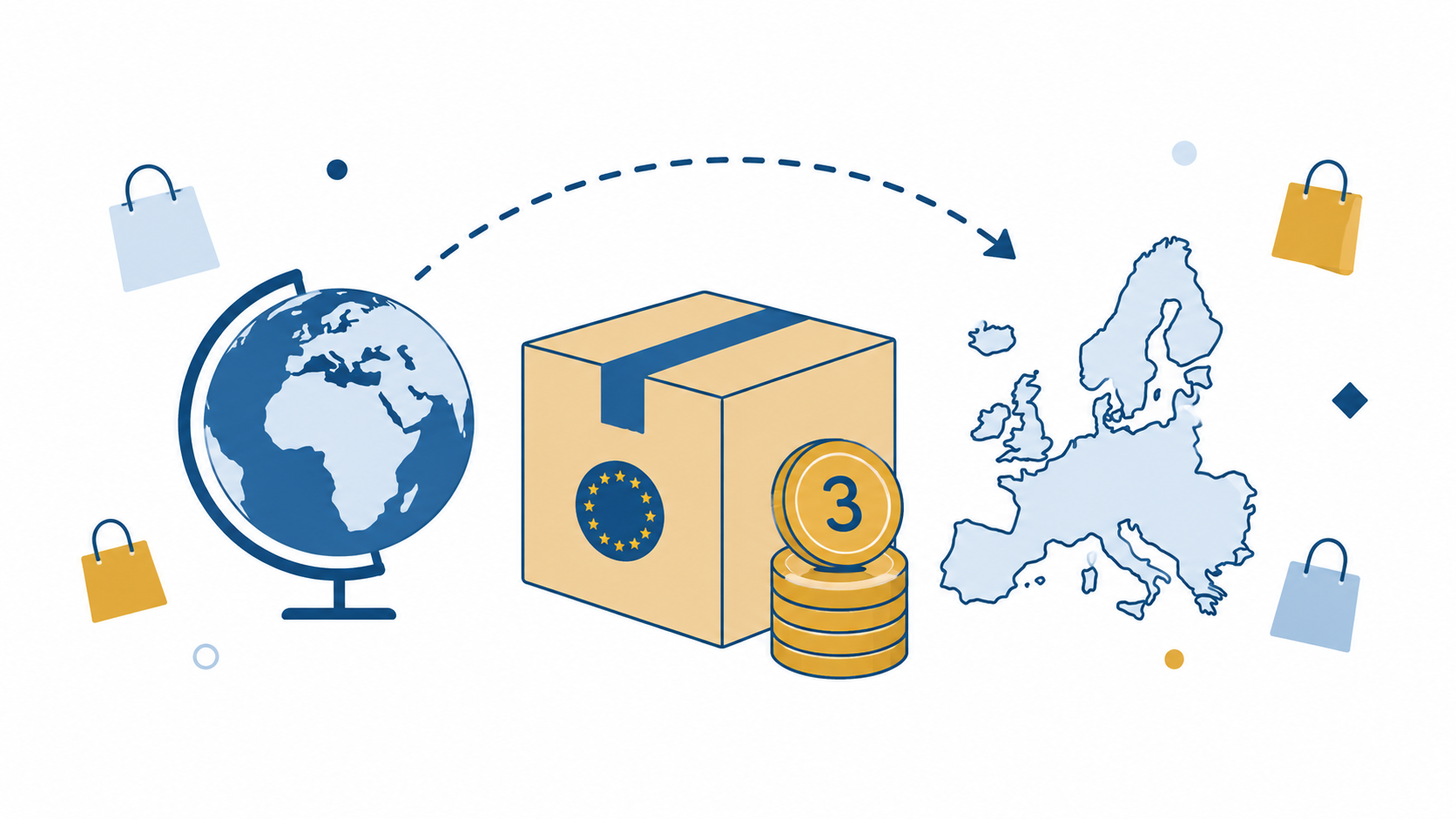
3 euros per item: the new EU customs fee on Shein, Temu and AliExpress orders
Short answer: from 1 July 2026 until 1 July 2028, orders of up to 150 € shipped from outside the EU (Shein, Temu, AliExpress and the like) pay 3 € per item line, on top of VAT. Three identical T-shirts are one line (3 €); a T-shirt and trousers are two (6 €). Orders shipped from an EU warehouse don’t pay it.
From 1 July 2026, the price of orders from platforms like Shein, Temu or AliExpress has changed — not because the platforms themselves raised prices, but because of a new European rule. EU Regulation 2026/382, of 11 February 2026 (published in the Official Journal of the EU on 18 February), eliminates a customs exemption that had been in place for decades.
If you buy clothes, electronics or anything else from sellers who ship from outside Europe, you now pay an additional 3 euros per item type as an import duty. This is on top of VAT, which has applied to these purchases since 2021.
What was the 150-euro exemption and why is it ending?
Until 30 June 2026, there was a customs exemption for packages worth less than 150 euros: orders below that value shipped from outside the EU entered without paying import duties. You only paid VAT.
This allowed Shein, Temu, AliExpress and other sellers shipping from China to price their products very cheaply, without the customs burden that European-based manufacturers and retailers face. European businesses have long complained this creates unfair competition.
The EU has moved to correct this. The exemption disappears, but instead of applying complex product-specific tariffs, the regulation introduces a flat simplified fee of 3 euros per item type (customs tariff line). This is a transitional measure: it runs until 1 July 2028, when the new EU Customs Data Hub is expected to be operational and will allow individualised duty calculation per product.
How the 3-euro fee works in practice
The duty is 3 euros per item type (per customs declaration line, technically speaking) — not per order and not per package. This has an important practical implication:
- If you order three identical T-shirts in one order → 3 euros (one item type).
- If you order a T-shirt and a pair of trousers → 6 euros (two distinct types).
- If you order a T-shirt, a pair of trousers and a pair of shoes → 9 euros (three distinct types).
What matters is not how many units you buy, but how many distinct product types are in the shipment. The technical detail is that grouping is done by customs code: two items sharing the same customs category may go on a single line. For low-value shipments, which are declared in a simplified way, the practical rule above is what applies almost always.
Most platforms already include the duty in the checkout, just as they do with VAT. You will see it as a separate line before confirming payment. Smaller platforms or sellers not registered in European customs systems may not have implemented this yet — in those cases, the courier will charge you the fee before delivering your package, and may also add a customs handling fee on top.
VAT still applies separately
The new customs duty does not replace VAT: both apply to the same purchase.
VAT (21% standard rate in Spain for most products) has been charged on these orders since July 2021, when the EU removed the old VAT exemption for purchases under 22 euros. Since then, all online purchases from outside the EU are subject to Spanish VAT regardless of the amount.
Now the customs duty is added on top. They are different charges:
- VAT taxes consumption (you pay it on every purchase, whether domestic or international).
- Customs duty taxes the entry of goods into European territory (it only applies to purchases from outside the EU).
For a 30-euro order with a single item type, the total cost would be roughly: 30 € for the product + 6.30 € VAT (21%) + 3 € duty = 39.30 euros. Worth bearing in mind when comparing prices between platforms.
Which platforms are affected and which are not
The key is the shipping origin, not where the platform is headquartered. If the product ships from outside the EU, the duty applies. If it ships from within the EU, it does not.
Typically affected:
- Shein: most shipments still come from China, though it has European warehouses for part of its catalogue.
- Temu: ships mainly from China.
- AliExpress: sellers shipping from China.
- Amazon: only for products sold by third-party sellers with stock outside the EU. Amazon products stored in Spain or another EU country do not pay the duty.
Generally not affected:
- Spanish or European retailers with EU-based warehouses: Zara, Mango, El Corte Inglés, ASOS (EU warehouse), etc.
- Amazon Prime products stored in EU fulfilment centres (those with guaranteed 1-2 day delivery typically meet this condition).
- Shein or Temu when shipping from their own EU-based warehouses (they have been expanding European capacity partly to avoid this duty).
Practical warning: on the same platform you can have products that pay the duty and others that do not, depending on the seller and the shipping warehouse. Always check the breakdown before confirming.
Orders over 150 euros: the change does not apply
If the intrinsic value of the order exceeds 150 euros, this flat fee does not apply. In that bracket, standard EU import duties already existed before (varying by product category — textile, electronics, footwear, etc. — and ranging from 0% to 20% or more, plus VAT). That has not changed.
The new measure only affects the 0–150 euro range, where the exemption previously applied.
What do you need to do?
In most cases, nothing different from before: the platform collects the duty at checkout and you will see it itemised when you finalise the order.
What is worth doing:
- Check the price breakdown before confirming. Some platforms may be slow to implement this, and the charge could appear as a separate cost at delivery.
- Factor in the extra cost when comparing prices across platforms. An item at 18 € on Shein (shipped from China) + 3 € duty + VAT may end up more expensive than the same item at 22 € from a Spanish retailer.
- Think about the number of item types per order if you regularly buy several different things at once: grouping similar items in the same order can reduce the total duty.
How much does this affect the household budget?
The impact depends on how much and what you buy on these platforms. A household making 2–3 orders a month on Shein or Temu with several distinct product types could see a monthly overrun of between 6 and 30 euros.
This is not a budget-changing amount, but it is one of those costs that, if you don’t account for it, ends up distorting what you thought you were spending on clothes or small online purchases. Alongside all your other regular household expenses, it deserves to appear in your monthly tracking as what it is: a real, unavoidable cost.
What about Cuéntamo? Not much here
Let’s be honest: with this change Cuéntamo can do little. It doesn’t calculate the duty, avoid it or make it deductible — for a household it’s consumption, not a deductible expense. The one thing it does, which is no magic but not nothing either, is help you keep track of that spending so it doesn’t stay hidden inside a Shein or Temu charge.
Since the duty comes already added to the charge, you just record the purchase (or import your bank statement) and assign it to your online-shopping category. That way, month after month, you see what these platforms really cost you — duty and VAT included — and decide with real data whether they still beat the European alternatives. It’s the same idea behind why many people ditch the spreadsheet: see the spending effortlessly, rather than chasing it.
If your struggle is keeping up the habit of logging it, you’ll recognise why you end up quitting budgeting apps — and how to avoid it.
Try it free at cuentamo.com.
Frequently asked questions
Do Shein, Temu and AliExpress charge the 3 euros?
Yes, when the order ships from outside the EU and its value does not exceed 150 euros: that covers most Shein, Temu and AliExpress orders. Only products shipped from a warehouse inside the EU escape it, and the same platform can mix both kinds in one basket.
Until when does the 3-euro fee apply?
From 1 July 2026 to 1 July 2028, according to the AEAT notice (Spanish-language source). It is a transitional measure.
Who charges me the 3-euro duty?
Normally the platform itself, at checkout, the same way it already collects VAT. For orders where the platform hasn’t implemented it yet, the courier may charge it before delivering your package, sometimes with an additional handling fee on top.
Does it affect all my orders on AliExpress or Shein?
Only orders shipped from outside the EU with an intrinsic value of up to 150 euros. If the product ships from a EU-based warehouse of the platform, the duty does not apply.
Is the fee permanent?
No. It runs until 1 July 2028, when the EU Customs Data Hub is expected to be operational. At that point, duties will be individualised by product category rather than a flat fee.
What if my order exceeds 150 euros?
If the intrinsic value of the order exceeds 150 euros, this flat 3-euro fee does not apply. Standard EU customs duties by product type apply instead — those already existed before and have not changed.
How do I know if an Amazon product ships from a EU warehouse?
Products labelled “Sold and dispatched by Amazon” with Prime delivery in 1–2 days typically come from European fulfilment centres. If the seller is a third party shipping from China or without Prime, the duty will likely apply.
Official sources: EU Regulation 2026/382, 11 February 2026 (Official Journal of the European Union); AEAT notice on e-commerce changes from 1 July 2026; Access2Markets, European Commission. Article written on 16 July 2026. This does not constitute personalised customs or legal advice; consult your adviser or a customs agent if you have questions about your specific situation.
This article is cross-checked against official sources and reviewed periodically. If you spot anything outdated, write to us at [email protected].