How to pay yourself a salary as a freelancer (without spending the tax money)
When you’re an employee, a fixed number lands in your account on payday. You know exactly what you have to work with, and everything else (taxes, social security) has already been taken out without you having to think about it. When you go freelance, that fixed number disappears. A client pays you 1,200 and, if you’re not careful, that 1,200 “feels like yours” the same day it lands in your account. It isn’t. Part of it has to go back out in taxes, another part covers business costs, and only what’s left after that is, genuinely, your salary.
This article is about putting order into that: setting aside what isn’t yours before you can spend it, and paying yourself a fixed, predictable amount instead of living off whatever’s left each month.
The root mistake: treating everything that comes in as yours
The first step, before even talking about salary, is to stop looking at your account balance as if it were your money. If you use the same account for everything (client payments, business expenses, groceries, going out), the balance tells you nothing useful. You don’t know how much is really yours and how much belongs to taxes you haven’t paid yet.
The fix isn’t complicated, but it is uncomfortable to adopt: separate business money from personal money, even if it’s just a separate account where client payments come in and business expenses go out. Everything that follows (setting aside taxes, calculating your salary, paying yourself) depends on that boundary existing. Without it, any calculation stays theoretical.
Before thinking about your salary: set aside taxes from every payment
Here’s the most expensive mistake a new freelancer makes: spending the tax money because, the moment it arrives, it looks available. That money was never fully yours. It belongs to the business, and part of the business belongs to the tax authorities.
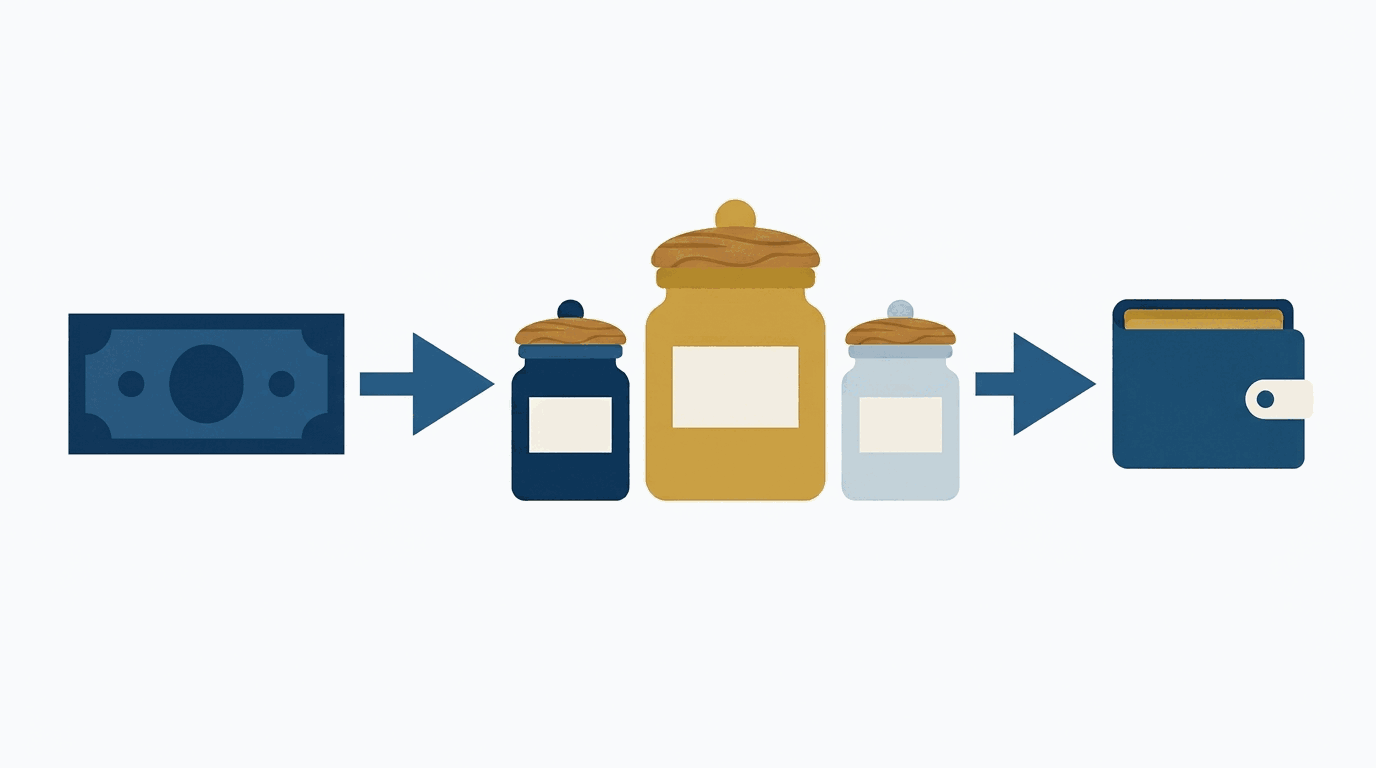
The simplest way to avoid this is to automate the set-aside the moment you get paid, not at the end of the quarter. As soon as an invoice gets paid, immediately transfer a portion to a separate account or pot, used exclusively for taxes. Don’t touch it until it’s actually time to pay them.
How much should you set aside? It depends on your activity and your specific situation, but a practical rule many freelancers use is setting aside somewhere between a quarter and a third of every payment. It’s better to set aside too much and have it left over (that surplus feeds your buffer) than to set aside too little and find a hole when it’s time to settle up.
Done well, this one step solves 80% of the stress of being self-employed. The money you see in the business account, once taxes are set aside, is real money you can count on.
Now the actual math: calculating your real salary
With taxes already set aside, what’s left in the business account splits into two places: the expenses the business needs to run (tools, professional subscriptions, whatever your work requires) and your salary, which is what you take home as a person.
The month-by-month calculation is:
Payments received this month − taxes set aside − business expenses = what’s available to pay yourself
The important nuance is in the next section: “what’s available” isn’t the same as “what you pay yourself.” Because if your income varies from month to month (and as a freelancer, it will), paying yourself exactly what’s available each month leaves your personal life at the mercy of that variation. That’s where the fixed salary comes in.
Pay yourself a fixed salary, not “whatever’s left”
The difference between a freelancer who lives at ease and one who lives with a constant sense of scarcity is almost never how much they invoice, it’s how they pay themselves. If you literally pay yourself whatever’s left each month, your personal life inherits all the instability of your business: months where you can afford anything, and months where you’re tightening the belt without quite knowing why.
The alternative is to treat yourself as your own employee. Decide on a fixed, conservative monthly figure, calculated on what you typically earn in a slow month (not a good one), and transfer it to your personal account on the same day every time, like a real payroll. That figure is what runs your personal life: rent, food, leisure, savings. And once that payroll lands in your personal account, treat it like any employee’s: setting your savings aside the same day you get paid is what stops the month from eating the part you meant to keep. Every other decision (whether this month went better than usual, whether to reinvest, whether it’s time to raise your own salary) gets made separately, calmly, not in the day-to-day scramble of paying bills.
This has an effect that’s easy to underestimate: it lets you plan your personal life with the same predictability as if you had a fixed salary, even while your business income stays irregular. The irregularity stays in the business account, which is where it can be absorbed without pain.
The business buffer: why your salary can’t drain the business account
For the fixed salary to work, the business account needs its own buffer, the same way your personal finances need an emergency fund. It’s the same logic, applied to the business: in good months, don’t raise your own salary at the same pace your income rises. Let the difference build up in the business account instead.
That buffer is what lets you keep your salary steady during a slow month without touching your personal savings or panicking. To work out how big it needs to be, the practical route is to forecast your cash flow for the coming months rather than guessing. If you get paid less than usual one month, the business account absorbs the difference; you still get paid the same as always. Only if the drop holds for several months in a row do you adjust the salary downward, deliberately, not overnight.
A worked example
Say your average monthly payments hover around 3,000, though they vary: some months 4,000, others 2,000.
- You set aside a third for taxes as soon as you get paid: roughly 1,000 a month on average.
- Business expenses (tools, subscriptions, whatever you need to work) run around 300.
- What’s left available, on average, is around 1,700 a month.
Instead of paying yourself that variable 1,700 every month, you decide on a fixed salary of 1,400, a bit below the average, calculated with slow months in mind rather than good ones. In months where more than 1,400 is available, the difference stays in the business account as a buffer. In months where you’re paid less than usual, that buffer covers the gap and you still take home your usual 1,400.
After a few months, that buffer gives you real breathing room: for a particularly slow month, for a business investment, or simply to sleep easy knowing your salary doesn’t depend on what happened to come in this specific week.
What to do in genuinely slow months
One month below normal changes nothing: that’s exactly what the business buffer is for. The problem shows up if the drop holds for several months in a row, because at that point it’s no longer an exception, it’s your new income level.
In that case, the right move isn’t to keep drawing on the buffer indefinitely hoping things improve on their own. It’s to sit down, review your real numbers, and lower the salary to a figure you can actually sustain with what you’re invoicing now. It’s an uncomfortable conversation to have with yourself, the same one you’d have if you were someone else’s employer and had to adjust a salary to the reality of the business. The sooner you have it, the less damage it does.
How does Cuéntamo help with this?
This whole method depends on one thing: knowing, at any moment, which part of the money you see in your account is genuinely yours and which is set aside for taxes or for the business buffer. Doing that in your head, or in a spreadsheet you have to update by hand, is exactly what most freelancers end up abandoning by the second month.
In Cuéntamo you can manage your freelance activity separately from your personal finances in the same place: every transaction is tagged with its scope, personal or freelance, so you can see at a glance how much comes in and goes out on each side without reconstructing anything. With auxiliary accounts you can create the equivalent of a tax jar: an account where you park the set-aside from every payment, without that money cluttering your income-and-expense reports as if it were yours to spend.
And because Cuéntamo runs your balance forecast forward using your real transactions and your recurring ones (including your own salary, if you set it up as a monthly recurring payment), you can see ahead of time whether the business buffer will hold through a slow month or whether it’s time to revisit what you pay yourself. The decision stays yours; the app just gives you the numbers to make it deliberately instead of by gut feeling.
You can try it for free at cuentamo.com.
Frequently asked questions
How much should I set aside from every payment for taxes?
It depends on your activity and situation, but a common practical benchmark among freelancers is setting aside somewhere between a quarter and a third of every payment, the moment you receive it. It’s better to set aside too much (the surplus adds to your buffer) than too little.
Why pay myself a fixed salary instead of whatever I earn each month?
Because if your personal pay rises and falls with every payment, your personal life inherits all of the business’s irregularity. A fixed salary, calculated on a slow month rather than a good one, gives you the same predictability as a regular paycheck, while the variation gets absorbed in the business account.
Do I need a separate bank account to do this?
It helps a lot to keep business money apart from personal money, even where it isn’t legally required. That can be a new bank account or, if you’d rather not open another one, a clear separation at the tracking level: tagging every transaction as personal or business and keeping each side’s books apart.
What if I can’t cover my fixed salary in a given month?
If it’s a one-off month, draw on the business buffer, that’s exactly what it’s for. If the drop holds for several months in a row, adjust the salary to a figure that’s sustainable with your current income, rather than waiting until the buffer runs completely dry.
How big a buffer does the business account need?
There’s no universal figure, but the more months of fixed costs (personal and business) it can cover, the more room you have to keep your salary steady through a rough patch. It’s the same reasoning as a personal emergency fund, applied to the business.
This article is checked against official sources and reviewed periodically. If you spot something out of date, write to us at [email protected].