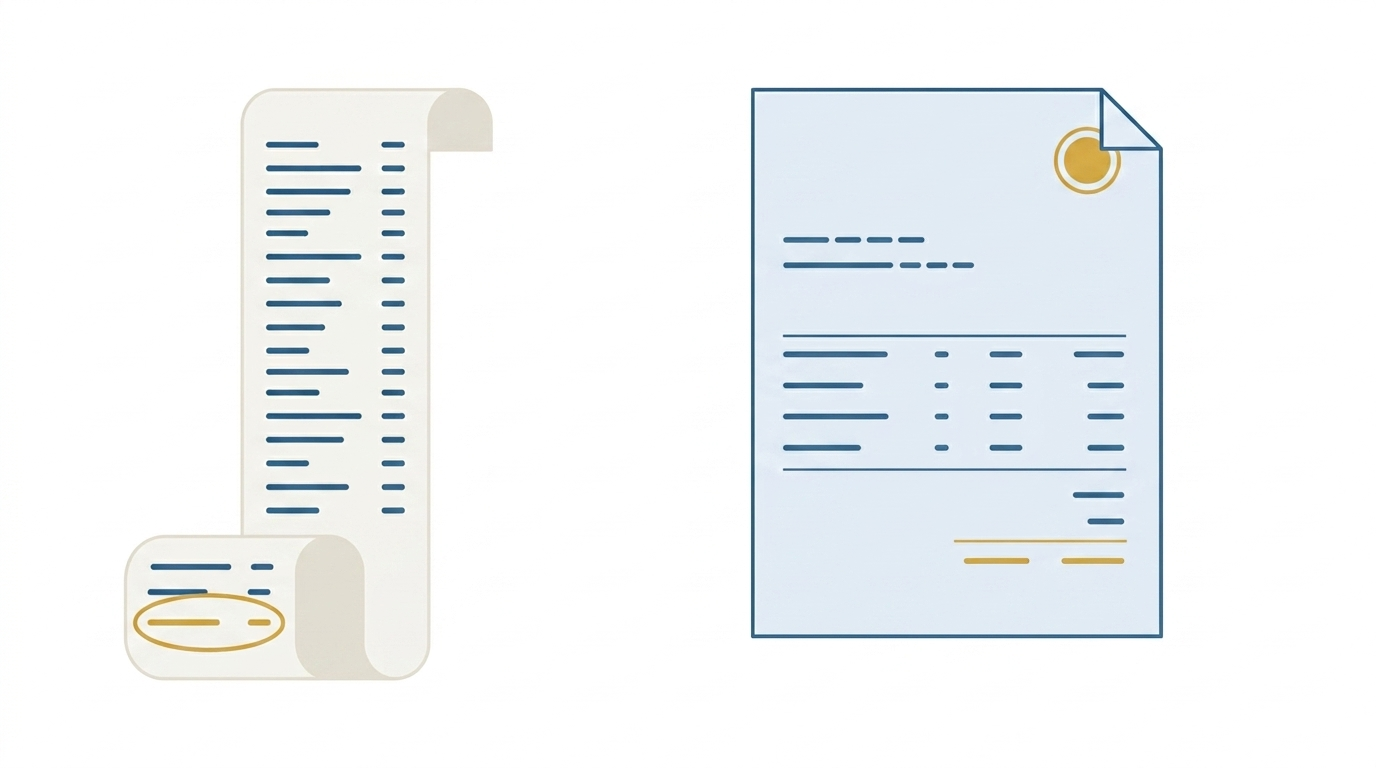
A till receipt is not an invoice: when you can deduct it and when you can't
You have lunch with a client, pay 48 euros and tuck the receipt into your wallet with a sense of duty done. Three months later, doing your quarterly return, that crumpled piece of paper is worth rather less than you thought: you can deduct the expense, but not the VAT. And not because the receipt is faulty, but because it’s missing one line you can only ask for at the moment you pay.
This is one of those things nobody tells you when you register as an autónomo (self-employed worker), and one that adds up over a year.
A receipt is an invoice (just a short one)
Let’s clear up a misunderstanding first. What we call a “receipt” has an official name: a simplified invoice (factura simplificada). It isn’t a second-class document or a workaround, it’s a real invoice, just with fewer details on it.
The Spanish Tax Agency (Agencia Tributaria) allows one to be issued when the amount doesn’t exceed 400 euros including VAT. And there’s a handful of sectors where the ceiling rises to 3,000 euros including VAT: retail sales, hospitality, passenger transport, hairdressing, parking and a few more. That’s why the restaurant, the taxi or the petrol station hand you a receipt by default: the law lets them.
The difference from a full invoice is what’s written on it. An ordinary simplified invoice carries the date, the number, the tax number of whoever is charging you, what they sold you, the VAT rate and the total. Notice what is not there: your details. Not your name, not your tax number, and no VAT broken out separately.
That’s where the whole problem lies.
Why the VAT falls through the cracks
To deduct the VAT you’ve paid, you need an invoice to back it up. The Agencia Tributaria puts it plainly: deductions “must be supported by an invoice issued by the business or professional who carried out the transaction”, and simplified invoices meeting the content of article 7.2 of the invoicing regulation count as such.
Article 7.2 is the key. It says that when the recipient is a business or professional who wants to deduct the VAT, the invoice must also state:
- Your tax number and your address.
- The VAT charged, shown separately.
A simplified invoice carrying those details is called a qualified simplified invoice (factura simplificada cualificada), which is the unlovely name for “the receipt with your tax number on it”. With one, you deduct VAT exactly as you would with a full invoice. Without, you don’t.
An example with numbers. A working lunch of 48.40 euros at the 10% VAT rate:
- Ordinary receipt: you get 48.40 euros as an expense and 0 euros of deductible VAT.
- Receipt with your details (qualified): a base of 44 euros and 4.40 euros of deductible VAT.
Four euros and change won’t rescue a quarter. But if you eat out twice a week, fill up every fortnight and buy supplies at the stationer’s round the corner, those four euros turn into several hundred a year that you’re giving away. To see the effect on your return, run the numbers through the quarterly VAT calculator.
So is the receipt good for anything?
Yes, and here it pays not to overcorrect: for income tax, the receipt usually works.
For an expense to be deductible under direct assessment it has to be linked to your activity, recorded in your official books, and supported. On that last point, the Agencia Tributaria refers to article 106 of the General Tax Act: expenses “must be supported, as a matter of priority, by an invoice”.
“As a matter of priority” is not the same as “exclusively”. The income tax manual itself clarifies that an invoice is not privileged evidence, and that other means of proof are admissible. In other words: a receipt, together with the bank entry and consistency with your line of work, supports an expense for income tax perfectly well.
The rule in one line: the receipt works for income tax; for VAT it needs your tax number on it.
The usual caveat applies: a well documented expense isn’t automatically a deductible one. Lunch with a client is; lunch on a random Tuesday by yourself isn’t. Documentation settles “how do I prove it”, not “this belongs to the business”.
What to do in practice
What matters happens in the ten seconds while you’re paying, not three months later.
Ask for your details at the time. “Can you put my tax number on it?” is a two-second question that any restaurant, petrol station or shop understands first time. Plenty of modern tills do it on the spot and reprint the receipt. Keeping your tax number in your phone’s notes helps more than you’d think.
Afterwards is late, though not impossible. You can go back and ask for an invoice, but the business is only obliged to issue one if you ask within the period allowed and you still have the original receipt. The more time passes, the more awkward the conversation.
Don’t waste effort on trivial amounts. A 1.50 euro coffee will deduct 0.14 euros of VAT. That’s not where your energy belongs. Where it does belong is in the recurring and the sizeable: working lunches, fuel, supplies, hotels, utilities. And watch out: for some of those — the car, the phone, the home — having the right invoice isn’t enough, because only the share used for the business is deductible.
Take the photo now. Petrol receipts fade: thermal paper loses its ink within months, and inside a car in summer, within weeks. You’re required to keep supporting documents for four years, and a blank piece of paper supports nothing. Photograph it the same day.
How we handle this in Cuéntamo
In Cuéntamo you can photograph the receipt from your phone and keep it attached to its transaction: the photo stays as supporting evidence, and the scan fills in the amount, date and merchant so you don’t have to type them. That’s exactly the moment to check whether it carries your tax number, because it’s while you still remember what it was for.
And for those with the freelancer module, every expense links to its entry in the official books, with its base and its VAT. So when the quarter comes round, you’re not deciding in a hurry what to deduct: it’s already decided. You can see how it all fits together on the freelancers page.
If you want to dig into the mechanics of the tax, we’ve explained what input and output VAT are and how to work out the VAT you owe each quarter without an accountant. And if you’re wrestling with what to record and where, here are the official books required under simplified direct assessment.
Frequently asked questions
Can I deduct the VAT on a restaurant receipt?
Only if the receipt carries your tax number, your address and the VAT amount shown separately (what’s called a qualified simplified invoice). An ordinary receipt doesn’t allow you to deduct the VAT, although the expense itself can still be deducted for income tax if it’s linked to your activity.
What’s the maximum amount for a simplified invoice?
400 euros including VAT as a general rule. In retail sales, hospitality, passenger transport, hairdressing or parking, among others, the ceiling rises to 3,000 euros including VAT.
Can I ask for a full invoice after they’ve given me the receipt?
You can, and the business must issue one if you request it within the period allowed and you still have the original receipt. In practice it’s far easier to ask for your details at the moment you pay.
Is a photo of the receipt enough, or do I need to keep the paper?
The photo is valid as supporting evidence and it also protects you from the thermal paper fading, which happens within a few months. You have to keep supporting documents for four years, so digitising them early is the sensible move.
If the receipt doesn’t carry my tax number, do I lose the income tax deduction too?
Not necessarily. For income tax the invoice is the priority means of support, but not the only one: the Agencia Tributaria manual admits other means of proof. A receipt with its matching bank entry, consistent with your activity, supports the expense.
In Cuéntamo you can photograph every receipt and leave it linked to its transaction, with its base and its VAT, so that by the time the quarter arrives it’s all already decided.
Figures for 2026. The simplified invoice ceilings (400 euros and 3,000 euros including VAT) and its content have been in force since 2013 (RD 1619/2012, arts. 4 and 7); the requirement for the tax number, address and separately stated VAT in order to deduct is in article 7.2 of that same regulation, confirmed by the Agencia Tributaria VAT manual. The priority of the invoice as support for an expense, and the fact that an invoice is not privileged evidence, are in the income tax manual (article 106 of the General Tax Act). The four-year retention period matches the tax statute of limitations (Ley 58/2003, art. 66).
This article is checked against official sources and reviewed periodically. If you spot anything out of date, email us at [email protected].