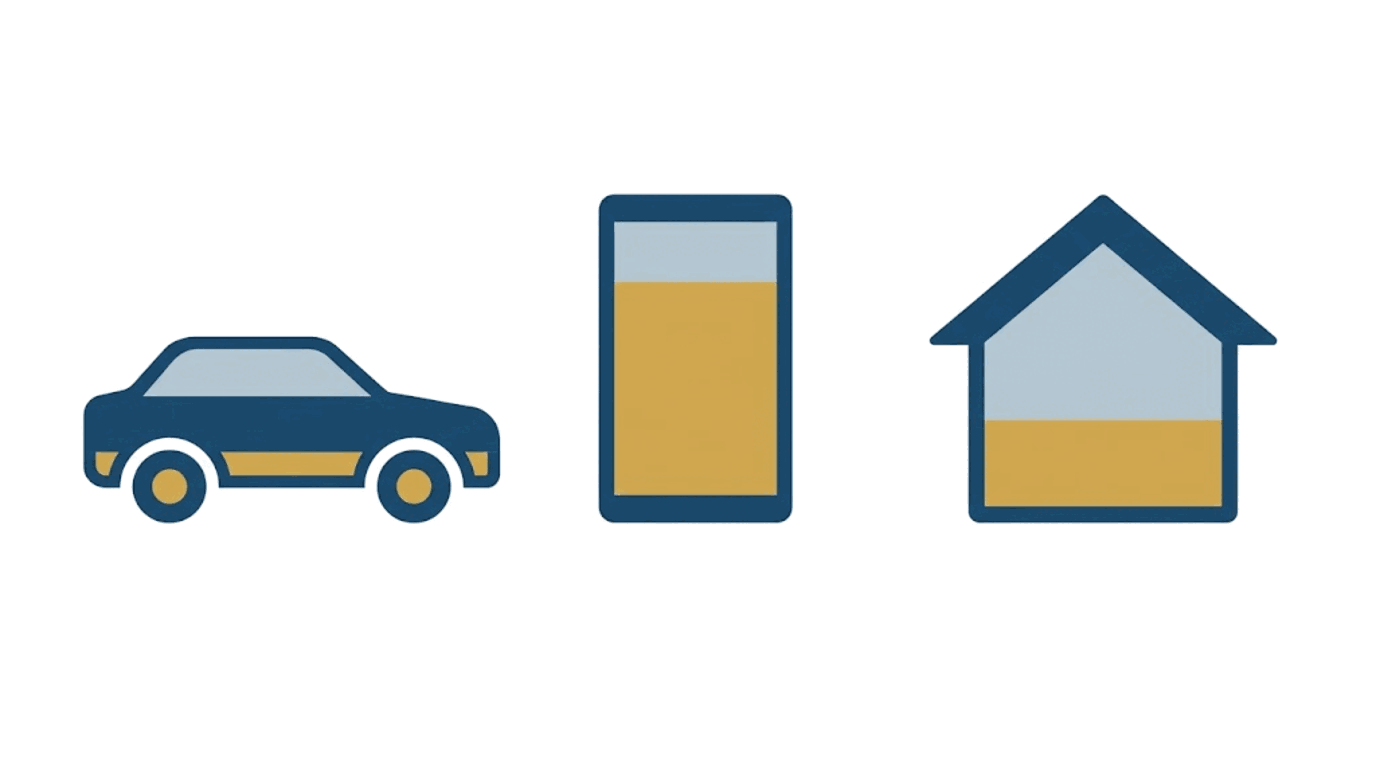
Deducting the car, the phone and the home as a freelancer: what the tax office accepts (and what it doesn't)
Some freelance expenses raise no doubt at all: office supplies, the software you use every day, your accountant. Then there are the car, the phone and the home, which happen to be the things you use for everything: for work and for life. That’s where almost every freelancer hesitates, and where the two opposite mistakes happen: deducting nothing out of fear, or deducting too much without realizing you’re taking on a real risk.
This article is about putting some order into those three specific expenses, without quoting legal articles along the way — they are all at the end, in the references, in case you want to check anything: what the tax office genuinely accepts, what it doesn’t, and why the difference between the two cases is almost always the same one. If you’re after the rest of the expenses you can deduct as a freelancer, you’ll find the full list in deductible expenses for the self-employed.
The idea that explains everything: exclusive use versus mixed use
Before getting into each expense, it helps to understand the underlying logic, because it repeats across all three cases.
If you use something only for your business (premises that are exclusively your workshop, a phone line only your clients call), the tax office accepts it as a 100% expense, no argument.1 The problem shows up when that same asset is also used for your personal life: the car you take to see a client on Tuesday and use to drop your kids at school the rest of the week, the phone you use to talk to suppliers and also to your family, the living room where you work in the mornings and watch TV at night.
That mixed use is where the doubt lives, and where the tax office is much stricter than most freelancers assume. “I also use it for work” isn’t enough on its own: you need to be able to back up how much, and that differs depending on which expense we’re talking about.
The car: the most restricted expense of all
Let’s start with the one that raises the most doubts and, at the same time, gets the harshest treatment. If your activity consists of moving around (transport, delivery, a sales rep who visits clients daily, a driving school, a taxi), the vehicle is a central part of your work and the full deduction is accepted, both for the vehicle and its associated costs (fuel, insurance, maintenance).2
For everyone else — the vast majority, who use the car occasionally to get to a meeting or run a business errand — the situation differs depending on which tax you look at. For VAT, the tax office starts from the assumption that half the vehicle’s use is professional, so half the VAT paid on fuel, repairs, tolls or parking can be deducted, always with an invoice and always if you can justify some genuine business use.3 For income tax, on the other hand, the criterion is far stricter: the vehicle has to be used exclusively for the business — not «almost» exclusively: the tax office does not allow even incidental private use — and sustaining that with a car you also use for your personal life is, in practice, impossible.4
The practical consequence: deducting the family car “because you use it for work some days” is one of the expenses that most often triggers a correction when the tax office reviews a return. If the car isn’t genuinely central to your activity, the sensible move is not to risk the income-tax deduction (you can still claim the 50% of VAT with the invoice), and if you really need a vehicle every day for work, consider one dedicated solely to the business instead of forcing the deduction on your everyday car. Keep in mind that a vehicle like that isn’t deducted in full in year one: as a capital asset, its cost is spread over several years, as we explain in the depreciation guide for the self-employed.
The phone: easy to solve, but not the way you think
The phone is the other side of the coin, though not in the way it usually gets told. There is no percentage to argue about here: the Directorate-General for Taxation has consistently held that the costs of a mobile line are deductible only if that line is used exclusively for the business.5 Deducting half your everyday phone bill “because you use it for everything” sounds reasonable, but it has no backing: it is the kind of thing that collapses the moment anyone looks at it.
What does work is the opposite, and it is cheap: take out a line exclusively for the business, separate from your personal number. That line is 100% deductible, and so is the handset, although its cost comes off through depreciation.5 It costs very little a month and turns a debatable expense into one that admits no debate.
And watch out for something that gets mixed up constantly: the 30% home-utilities rule you will see in the next section does not cover the mobile, because it is not a utility of the home. The landline and the home internet are; the mobile is not.6
The home: what you can really deduct if you work from the living room
Working from home is increasingly common, and it’s also where people most overestimate what they can deduct. The general idea is this: you can deduct the part of your home that you genuinely dedicate to the business, but calculated with a doubly proportional criterion, not as if the whole house were your office.
First you work out what proportion of the home the workspace takes up (a 12 square metre room in an 80 square metre flat is 15% of the home). Then, on utilities — electricity, water, gas, internet — only up to 30% of that proportion is accepted as deductible, not the full proportion.7 Following the example: 30% of that 15% is 4.5% of the total bill. If you pay 150 a month in utilities, that’s roughly 7 a month, a bit over 80 a year. It’s real, and worth claiming, but it helps to keep your expectations in check: you’re not going to deduct “half the house” for working from the living room.
If you rent your home, the portion of rent corresponding to that space can be deducted with the same proportional criterion (here without the 30% cap, which only applies to utilities). What’s essential in both cases is that the space is formally declared as dedicated to the business and appears in your official records: without that step first, the deduction has no backing if it’s ever reviewed.8
How you actually declare that space
You do it with form 036, the census return. If you are already registered — the normal case if you have been going a while — this is not a new registration: it is a modification return, ticking the activities-and-premises box and adding your home as a place where you carry out the activity.9
What it asks about that space is short and concrete: the address, the square metres you use for the activity and the degree of affectation, that is, whether you use it only for work or also for your personal life.9 That is where the proportion behind the whole utilities calculation gets put in writing.
Two details worth not skipping. The deadline is one month from the change, so it isn’t something to sort out in June while doing your annual return.10 And form 036 on its own isn’t enough: the space also has to appear in your official records, because the rule expressly excludes whatever doesn’t.8
One note in case you run into older information: form 037, the simplified version many people used for this, no longer exists; it was abolished on 3 February 2025 and everything now goes through form 036.11
Why the risk outweighs the savings when you overreach
There’s a pattern across all three cases: aggressively deducting a mixed-use expense rarely compensates for the risk you’re taking on. If the tax office reviews your return and rejects an expense you’ve been deducting for years — the whole family car, 100% of the home’s utilities — you don’t just lose that year’s deduction: you pay the difference plus late-payment interest and you may also be fined, and the review reaches back over the four years that haven’t lapsed yet.12 The few hundred euros a year you saved can turn into a much bigger bill a few years later. It is worth knowing the treatment differs if you are the one who corrects it before being asked: then there is a surcharge, but no penalty.13
The healthiest way to feel at ease isn’t to deduct the bare minimum out of fear, but to deduct exactly what you can back up: with the phone line kept separate, with the home space properly declared, with a vehicle dedicated to the business if you genuinely need one daily. Exclusivity, whenever you can get it, is worth more than any percentage.
How does Cuéntamo help with this?
The problem with these expenses is almost never knowing the general rule (once you read it, it makes sense), but applying it consistently every time you log an expense, month after month, without having to think it through again. In Cuéntamo’s freelance module you can set, once, what percentage of an expense in a given category or tag — say “Car” or “Utilities” — is deductible for income tax, and what share of its VAT is deductible on the quarterly return. From then on, every expense you log under that category automatically inherits the right percentage, with nothing to remember or recalculate each time.
And because every expense is logged with its counterparty, its invoice and its tax treatment from day one, if you’re ever asked to justify a mixed-use expense you have the criterion you applied from the start, not a rushed reconstruction at year’s end.
You can try it for free at cuentamo.com.
Frequently asked questions
Can I deduct my car if I use it to see clients occasionally?
For VAT, yes, partially: the tax office presumes 50% professional use for passenger cars, so you can deduct half the VAT paid on fuel, repairs, tolls or parking if you justify some professional use.3 Insurance is not part of that: insurance transactions are VAT-exempt, so there is no VAT to reclaim. For income tax, no: the vehicle has to be used exclusively for the business, and the tax office does not accept even incidental private use — impossible to sustain if it is also your family car.4
What percentage of my phone can I deduct if I use it for everything?
None. The Directorate-General for Taxation holds that the costs of a mobile line are deductible only if the line is used exclusively for the business; there is no accepted partial percentage for a mixed-use mobile.5 The practical way out is a second, dedicated line, which is 100% deductible. And don’t confuse this with the 30% home-utilities rule: that one does not reach the mobile.6
How much can I deduct from utilities if I work from home?
It’s calculated in two steps: first the proportion of the home your workspace takes up, then 30% of that proportion applied to the utilities bill. The law does allow proving a different percentage, higher or lower, but the burden of proof is on you.7 In practice it tends to be a modest share of the total bill, not a large one.
What happens if the tax office reviews an expense I’ve been deducting wrong for years?
Besides losing the deduction, you pay the difference with late-payment interest and you may receive a penalty, and the review reaches the four years that haven’t lapsed.12 If you are the one who corrects it before the tax office asks, there is no penalty: only a surcharge, which is considerably milder.13 That’s why it’s worth deducting only what you can back up, not the maximum possible.
Do I need to formally declare that I work from home?
Yes. To deduct the proportional share of utilities or rent corresponding to your workspace, that space must be declared as dedicated to the business and appear in your official records. Without that step, the deduction has no backing if it’s reviewed.8 You declare it on form 036 — a modification return if you are already registered — stating the address, the square metres used for the activity and the degree of affectation, and you have one month from the change.9 10 Form 037 no longer applies: it was abolished in February 2025.11
This article is checked against official sources and reviewed periodically. If you spot something out of date, write to us at [email protected].
Article 29 of Law 35/2006, on personal income tax and article 22, paragraphs 2 and 3, of the Income Tax Regulation (Royal Decree 439/2007). Assets “used simultaneously for economic activities and for private needs” are not treated as business assets, unless the private use is incidental and notoriously irrelevant; and “indivisible assets shall in no case be capable of partial affectation”. Spanish-language sources. ↩︎
Article 22.4 of the Income Tax Regulation, which exempts from the strict criterion mixed vehicles used to transport goods, passenger transport for consideration, driving instruction, the travel of commercial representatives or agents, and habitual hire for consideration. The equivalent list for VAT is in article 95.Three.2ª of Law 37/1992, on VAT. ↩︎
Article 95.Three.2ª of the VAT Act: passenger cars “shall be presumed to be used for the business activity in a proportion of 50 per cent”. Article 95.Four extends the rule to accessories and spare parts, fuel, parking and tolls, and repairs. Vehicle insurance falls outside it because insurance transactions are VAT-exempt (article 20.One.16 of the same act): there is no input VAT to reclaim. The 50% presumption can be adjusted either way, and the actual degree of use must be provable (article 95.Three, rules 3ª and 4ª). ↩︎ ↩︎
Binding ruling V0354-20 of the Directorate-General for Taxation (14 February 2020): deducting the costs of a passenger car “requires that it qualify as an asset affected to the activity, which means that, being recorded in the compulsory books or registers, it is used exclusively in that activity”, save for the exceptions in article 22.4 of the Regulation. The tax agency puts it the same way in its affectation criteria: passenger cars qualify only “when they are used exclusively for the purposes of the activity, and may in no case be considered affected where they are also used for private needs, not even where such use is incidental”. ↩︎ ↩︎
Binding ruling V0031-24 of the Directorate-General for Taxation, restating its settled doctrine (rulings V0601-14, V2382-13 and V2400-13): the costs “shall be deductible to the extent that this line is used exclusively for the development of the economic activity”. The handset follows the same fate and is deducted through depreciation. The criterion still stands in ruling V1606-26, of 17 June 2026. ↩︎ ↩︎ ↩︎
Binding ruling V2554-23: the objective 30% rule “shall not apply to the costs arising from the use of a mobile telephone line, as it is not a utility associated with a dwelling”. When listing home utilities, the Directorate-General for Taxation refers to “fixed-line telephony and Internet”. ↩︎ ↩︎
Article 30.2, rule 5ª, letter b) of the Income Tax Act, as worded by article 11 of Law 6/2017 on Urgent Reforms of Self-Employment, in force since 1 January 2018: utilities of a partially affected home — “water, gas, electricity, telephony and Internet” — are deducted “in the percentage resulting from applying 30 per cent to the ratio between the square metres of the dwelling used for the activity and its total area, unless a higher or lower percentage is proven”. Applied to a concrete case in ruling V0354-20. ↩︎ ↩︎
Article 22.2.2 of the Income Tax Regulation: assets that “do not appear in the accounts or official registers of the economic activity that the taxpayer is obliged to keep” are not treated as affected, unless proven otherwise. The affectation of the property is notified in the census return (form 036). ↩︎ ↩︎ ↩︎
Article 5.12 of the General Regulation on tax management and inspection procedures (Royal Decree 1065/2007): the census includes “the list, where applicable, of the establishments or premises in which economic activities are carried out, identifying the autonomous community, province, municipality, full address and the cadastral reference of each”. The modification return is governed by article 10 of the same regulation. The specific data the form asks for — “surface area of the premises or of the habitual dwelling used for the activity (in square metres)” and “degree of affectation of the premises or of the habitual dwelling used for the activity (for example, whether it is used exclusively or partially for the activity)” — appear in the tax agency’s Censos WEB help manual. Spanish-language sources. ↩︎ ↩︎ ↩︎
Article 10.4 of Royal Decree 1065/2007: “The return must be filed within one month from the events giving rise to it”, save for the special cases the article itself lists. ↩︎ ↩︎
Form 037 was abolished with effect from 3 February 2025 by article 1.6 of Order HAC/1526/2024, of 11 December. This can be checked in the consolidated text of Order EHA/1274/2007, where article 14 (“Filing deadline for form 037”) is shown as suppressed. ↩︎ ↩︎
Late-payment interest, article 26 of Law 58/2003, the General Tax Act; the offence of failing to pay the tax due, article 191 of the same act; the four-year limitation period, article 66 of the same act. ↩︎ ↩︎
Article 27 of the General Tax Act: surcharges apply to self-assessments filed late “without prior request from the tax authorities”. That is why article 191 expressly excludes from the offence those cases regularised under article 27: if you get there first, there is a surcharge but no penalty. ↩︎ ↩︎