Pay yourself first: automate your savings on payday
You get paid, cover the usual bills, and at the end of the month you look at whatever’s left to “save.” Most months there isn’t much, and some months there’s nothing. The problem isn’t that you earn too little or spend badly: it’s the order. If savings go last in line, they lose to whatever expense shows up first.
The tip: flip the order
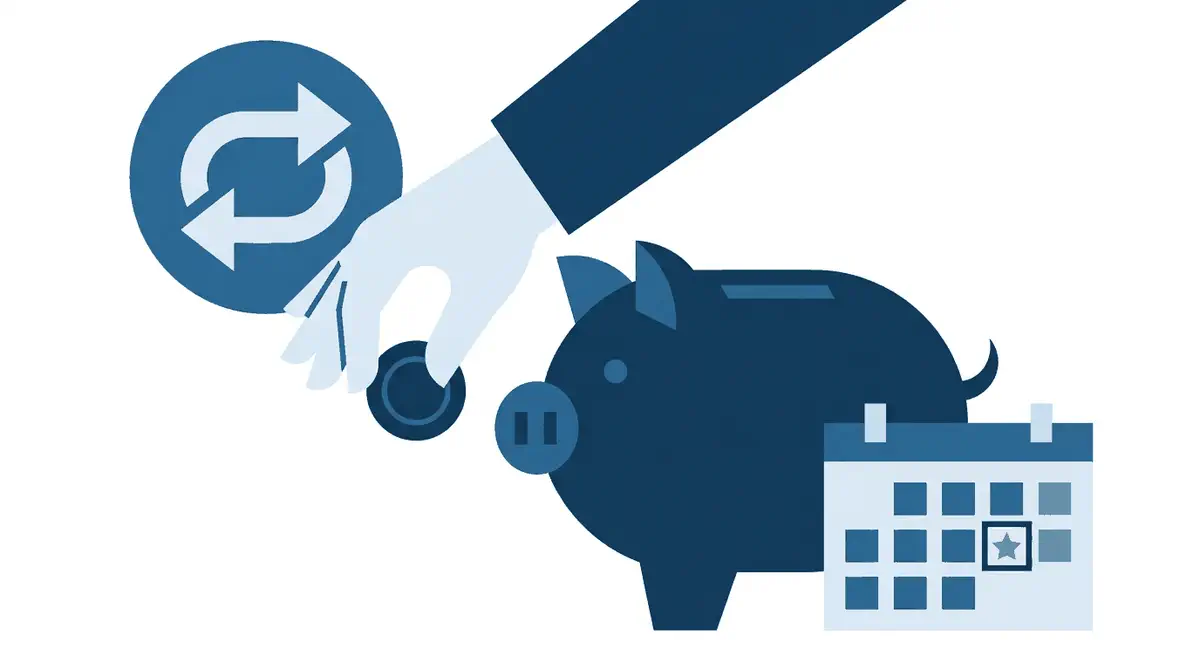
The idea fits in one sentence: treat savings like just another fixed bill, not like whatever’s left over. Instead of spending and seeing what remains, set aside a fixed amount first — an automatic transfer, the same day or the day after you get paid — and live on what’s left afterward. Money that never reaches your everyday checking account is money you won’t spend without noticing.
You don’t need a heroic figure to start. What matters isn’t how much you set aside the first time, but that the move is automatic: a scheduled transfer, not a decision you make (or put off) every single month.
An example with numbers
Say you earn €1,800 a month. Saving “whatever’s left over,” your real average over the last few months has been around €40: some months you drop to zero, some months you get a nice surprise of €90. Nothing stable, because it depends entirely on how the month went.
Now try the opposite: the day your paycheck lands, you set up an automatic transfer of €150 (about 8% of your income) to a separate account you don’t use day to day. You live on the remaining €1,650 for the rest of the month — exactly the same way you used to live on whatever was left over before.
After a year: €1,800 saved automatically, versus the €480 that those €40-a-month averages added up to through sheer willpower. The difference isn’t that you’re earning more or spending less: it’s that savings stopped competing with every other expense for last place in line. And if you put that money somewhere that earns a return instead of letting it sit idle, it starts working on its own thanks to compound interest. Saving is the clearest example, but the principle holds for anything that has to happen every month: if it depends on you remembering, it won’t happen.
How to apply this today
Three steps, and all three can be done in a few minutes from your bank’s website:
- Decide on a fixed amount, not a mental percentage you re-adjust every month. 5-10% of your income is a reasonable starting point if you don’t know where to begin; you can always raise it later.
- Schedule the transfer for the same day you get paid, or the day after at the latest. The more time passes between getting paid and setting money aside, the easier it is for that money to already be committed to something else.
- Send that money to an account you don’t check every week. If you leave it in the same account you pay your everyday bills from, sooner or later you’ll end up “borrowing it back” without meaning to.
Repeated every month without you having to think about it, the habit becomes invisible: you stop needing discipline, because the decision is already made once and for all.
How does Cuéntamo help with this?
Cuéntamo doesn’t move the money for you — that’s what the standing order at your bank does — but it does show you whether the habit is working. With a savings goal you can set the amount you want to reach, with or without a deadline, and see your current balance and the projected date at the pace you’re actually contributing, without keeping track by hand. If you tag those automatic transfers, your progress updates itself every time a new one comes in.
And if what you’re building with those contributions is a cushion for the unexpected, this same habit is the most direct way to build your emergency fund without relying on remembering to do it every month.
You can try it for free at cuentamo.com.
Frequently asked questions
How much should I set aside if I don’t know where to start?
Start with a figure that won’t hurt, even if it’s small: 5% of your income already beats the 0% that comes from “saving whatever’s left over.” What matters is that the transfer happens on its own every month; you can raise the amount later, once you confirm you can live on what remains.
What if some month I can’t cover my expenses with what’s left?
Lower the automatic amount that month, don’t cancel it. The goal isn’t to force an impossible figure — it’s for savings to take priority over the expenses you can trim, not the ones you can’t.
Where should I keep that automatic money?
Any account different from the one you use daily already does the job of removing the temptation. If it’s also an interest-bearing account or a simple product that pays you something, even better: it doesn’t change the habit, but it puts the money you set aside to work a little on its own while you don’t need it.
This article is checked against official sources and reviewed periodically. If you spot something out of date, write to us at [email protected].