Modelo 390: What Spain's Annual VAT Summary Is and How It Ties to Your Quarterly Returns
Four quarterly modelo 303 returns, four payments to the Agencia Tributaria, and then at the end of the tax year comes one more declaration: the modelo 390. For many autónomos (self-employed workers) this is the one that generates the most questions — not because it’s complicated, but because it’s not clear what it’s actually for if you’ve already filed all four 303s for the year.
The short answer: the 390 is not a new tax payment. It’s the year-end close. The document that says “here’s everything I charged, everything I paid, and everything I’ve settled with the tax authority over the year, added up”. It’s also your last chance to spot anything in the quarterly returns that doesn’t add up.
Why the modelo 390 exists
The modelo 303 is a periodic declaration: each time a tax period closes, you declare the VAT for that period. But the Agencia Tributaria also wants a picture of the full tax year, not just four partial snapshots.
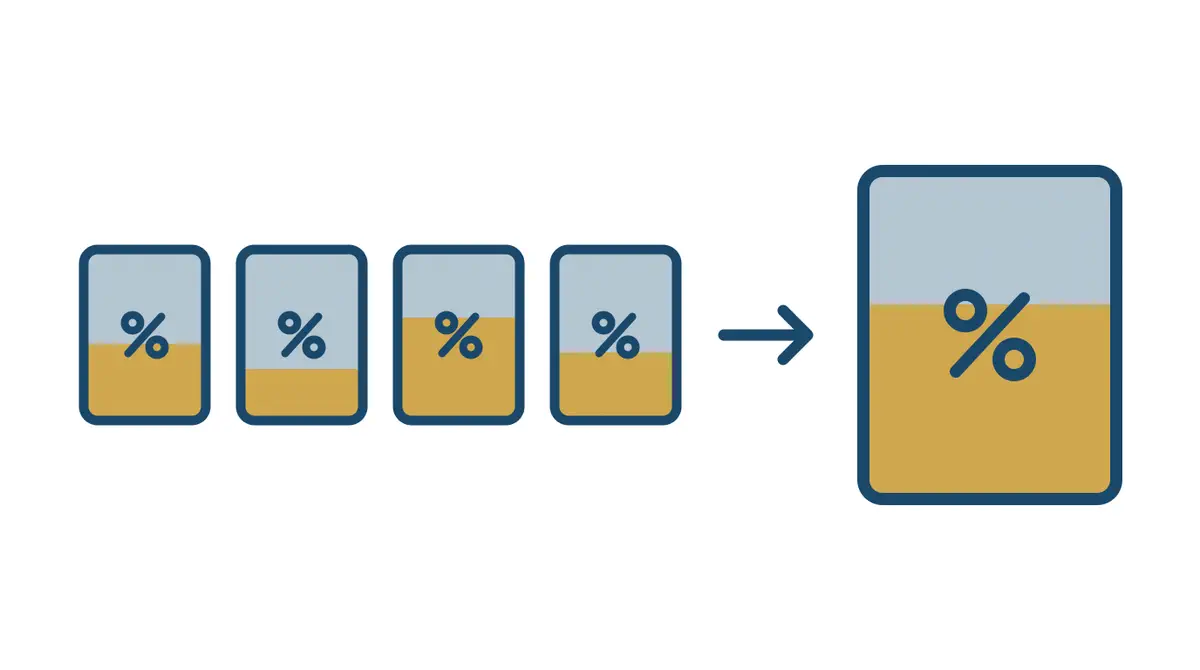
The modelo 390 is that picture. It aggregates the totals across all periods of the year — accumulated output VAT, accumulated input VAT, overall result — and presents them in consolidated form. It serves as a year-end record and as a cross-check tool for both the autónomo and the tax authority.
Who has to file it
The obligation comes straight from the VAT Act: on top of the periodic returns, “taxable persons must file an annual summary return”.1 So the general rule is simple: if you file the 303, you file the 390.2
First, a territorial point that often slips through: VAT does not apply in the Canary Islands, Ceuta or Melilla.3 The Canaries have their own tax (IGIC) and Ceuta and Melilla have the IPSI, each with its own forms. If you’re taxed there, the 390 isn’t for you.
There is one concrete exemption worth knowing, because it covers a lot of people. Taxable persons on a quarterly settlement period who, being taxed only in the common territory, carry out exclusively one of these two activities (or both) are excluded from filing the 390:4
- activities taxed under the simplified VAT regime (módulos), and/or
- the letting of urban property.
Those who carry out exclusively exempt operations under articles 20 and 26 of the VAT Act are not required to file it either.5 Outside those cases, you most likely have to file it.
If you’re taxed in a foral territory — Álava, Bizkaia, Gipuzkoa or Navarre — the annual summary follows each foral tax authority’s own rules, which differ from those of the common territory, including the role the 390 plays with respect to the final period of the year. Check directly with your foral authority before assuming that what applies elsewhere in Spain applies to you.
How it relates to the modelo 303
The 390 doesn’t replace the 303 or add new amounts. It’s strictly a summary: it adds up the data from all four periods of the year and presents them in aggregate form.
If your four 303s are correct, the 390 should follow automatically by adding up the totals. The value of filing it lies precisely in the fact that the act of aggregating can reveal errors that the individual periods don’t expose: a VAT amount entered in the wrong box, a carry-forward applied incorrectly, an invoice counted twice.
To get a solid grasp of the mechanics behind it — what input and output VAT are and how the quarterly amount is worked out — it helps to have those concepts clear before tackling the 390.
The boxes that matter most
This part is for when you already have the form in front of you. If you only wanted to know whether it applies to you and by when, everything above has you covered; this is the map so you don’t get lost once you open it.
The modelo 390 is longer than the 303, but once you understand the logic there are no mysterious boxes: everything is a sum of what you already declared period by period.
Output VAT block
Here you enter the annual totals of your output VAT, grouped by tax rate. If across the four periods of the year you’ve issued invoices at the standard 21% rate, the boxes for that rate show the sum of the four taxable bases and the four VAT amounts.
The structure mirrors the 303: one box for the taxable base, another for the VAT charge, and separate rows for the standard rate (21%), the reduced rate (10%) and the super-reduced rate (4%). If you only invoice at one rate, the other rows are zero.
Input VAT block
The same approach, but for expenses: you add up the input VAT from all four periods and classify it accordingly — current expenses, capital goods, intra-EU acquisitions.
For most autónomos with straightforward activity, the bulk is in the current purchases and services boxes: the accumulated total of deductible expense invoices over the year.
Overall result
Here the 390 shows the result for the complete tax year. It doesn’t generate any payment or refund on its own — that was handled by each of the 303s. The 390 result is informational: it tells you whether the year worked out in your favour or against you overall.
If any period produced a negative result that you chose to carry forward, the corresponding boxes in the 390 will show the amounts carried and any balance still pending. How that carry-forward works is covered in VAT to offset from previous quarters, and how long you can keep it going before you have to request a refund instead, in how long you can carry forward VAT to offset before you lose it.
Settlement results
These boxes record everything you paid or received back over the course of the year, period by period. They allow the 390 to close the year coherently: the Agencia Tributaria can verify that the sum of your four 303s matches the annual totals in the 390.
How to reconcile it with your 303s
The most practical approach to filling in the 390 without errors is this: pull out all four filed 303s and add up the equivalent boxes.
- The 390’s annual taxable base at 21% = sum of the 21% taxable bases across your four 303s.
- The 390’s annual output VAT at 21% = sum of the 21% output VAT figures across your four 303s.
- The 390’s total deductible VAT = sum of the total deductible VAT figures across your four 303s.
- And so on for each block.
If the sums match, the 390 is correct. If there’s a discrepancy, that’s your clue to go back to the period that doesn’t balance and check whether an invoice was missed, an amount was mis-entered or a box was used incorrectly.
Working in reverse is also useful: if the 390 doesn’t balance, the error usually lies in one of the 303s, and finding it now — before the Agencia Tributaria does — lets you file a supplementary or corrected return without it becoming a bigger issue.
If you need to brush up on how to fill in the quarterly form, the step-by-step guide to the modelo 303 walks through every box with a real example.
When it’s filed
The deadline is the first thirty calendar days of January of the year following the one the return covers.6 Note the detail: it’s thirty days, so the last day is 30 January, not the 31st. For the full map of due dates, see the autónomo tax calendar. It’s a silly, avoidable mistake that catches someone out every year.
The five-minute check before you call it done
If you take away one practical thing from all this, make it this list. With your four 303s in front of you:
- Do they add up? The 390’s annual base at 21% = the sum of the four bases at 21%. Same for the output VAT and the deductible VAT. If that balances, the rest usually follows.
- Is the fourth quarter in there? It’s the one most often forgotten, because it’s filed in the same month.
- Did you claim the refund where you were supposed to? If you closed the year with a balance in your favour, that box belonged in the Q4 303. There’s still time to fix it.
- Do services bought from outside Spain show up? Advertising, software, cloud storage: they have their own block and are the most common omission.
- Are the figures taxable bases? Not gross amounts with VAT included. It’s the silliest and the most frequent mistake.
If any of this doesn’t add up, don’t file yet: find the period that’s off first. Correcting a 303 now is far cheaper than answering a tax review two years from now.
The most common mistakes
Filing it without reviewing the 303s first. The 390 doesn’t automatically fix errors in the quarterly returns. If any 303 has a wrong amount, the 390 carries it over. Reviewing beforehand is your chance to catch them.
Confusing the taxable base with the invoice total. Just like the 303, the 390 asks for taxable bases, not gross amounts including VAT. It’s the most frequent mistake and the easiest to avoid if you take your time.
Forgetting intra-EU transactions. If during the year you purchased services from suppliers in other EU countries (software platforms, digital advertising, cloud storage), those operations have their own block in the 390. If they weren’t entered correctly in the 303s, the 390 is when you’ll catch the omission. And they carry their own separate informational return: the modelo 349.
Assuming the foral rules are the same as the common-territory ones. If you’re taxed in Álava, Bizkaia, Gipuzkoa or Navarre, the annual summary follows your foral tax authority’s rules, and both the deadlines and the role of the 390 with respect to the final period may not match what applies in the common territory. Check the source that applies to you before acting on what you’ve read for the rest of Spain.
Leaving it to the last minute. The 390 arrives just after the year closes, when administrative workload tends to be heaviest. Having all four 303s organised and accessible throughout the year makes the job much lighter: the figures are all there, no reconstruction needed.
How Cuéntamo helps with this
If you track your invoices in Cuéntamo, the autónomos module already has your periodic VAT settlements calculated — output and input VAT broken down by rate. For the modelo 390, you just aggregate those totals.
The settlements screen shows each period’s data separately, so adding them up is quick. Carry-forward amounts are recorded too, making it straightforward to fill in the 390’s corresponding boxes without having to reconstruct anything by hand.
Before sitting down with the form, it’s worth having input and output VAT clear in your mind, and knowing how the modelo 303 works: the 390 has no secrets once your quarterly returns are in order.
Try it free at cuentamo.com.
Frequently asked questions
Does the modelo 390 generate an extra payment?
No. The modelo 390 is an informational summary: payments (or carry-forwards) are generated by each periodic return. The 390 doesn’t involve any extra charge or new refund.
What happens if the 390 doesn’t match my 303s?
If the sum of your 303s doesn’t match the 390 totals, there’s an error somewhere. The usual fix is to file a supplementary or corrected return for the period that doesn’t balance. It’s better to catch and correct it than to leave it. Fixing it in time is far cheaper than waiting for the tax office to find it.
How do I know whether I’m required to file the modelo 390?
In general, if you file the modelo 303 under the general VAT regime, you have to file the 390. Exemptions exist for specific regimes like the agriculture special regime or the simplified flat-rate scheme in certain cases. If in doubt, check on the Agencia Tributaria’s electronic office.
How do I reconcile the 390 with my four 303s?
The most practical approach is to add up the equivalent boxes across all four 303s and compare those totals with the 390. The 390’s annual taxable base should equal the sum of the taxable bases from all four periods. Any discrepancy usually points to an error in one of the 303s.
Can I claim a refund through the modelo 390?
No. This is a common mix-up and worth getting right, because getting it wrong costs money. If you’re left with a balance in your favour at 31 December that you haven’t been able to offset, the refund is requested in the return for the final period of the year — that is, the fourth-quarter 303 (or December’s, if you settle monthly) — not in the 390.7
The 390 is filed in that same month of January, so it’s easy to assume there will be a chance to ask for it there. There isn’t: the 390 is informational and has no box for requesting the refund. If you didn’t tick the relevant box in your last 303, you’ll have to correct that return.
References
This article is cross-checked against official sources and reviewed periodically. If you spot anything out of date, write to us at [email protected].
Article 164.Uno.6 of the VAT Act (Ley 37/1992): after the obligation to file periodic returns, “notwithstanding the preceding paragraph, taxable persons must file an annual summary return”. The implementing rules are in article 71.7 of the VAT Regulation (Real Decreto 1624/1992). ↩︎
The form is approved by Orden EHA/3111/2009, of 5 November, whose article 1.2 states that it “shall be filed by taxable persons required to file periodic returns”. ↩︎
Article 3 of Ley 37/1992: excluded from the scope of the tax are “in the Kingdom of Spain, Ceuta and Melilla”, as territories outside the Customs Union, and “in the Kingdom of Spain, the Canary Islands”, as a territory excluded from the harmonisation of turnover taxes. ↩︎
Article 1.3.a) of Orden EHA/3111/2009: excluded are taxable persons “on a quarterly settlement period who, being taxed only in the common territory, carry out exclusively” activities “taxed under the simplified VAT regime” and/or “the letting of urban property”. ↩︎
Article 71.7, third paragraph, of the VAT Regulation: those who “carry out exclusively the exempt operations covered by articles 20 and 26 of the Act” are not required to file the annual summary return. ↩︎
Article 8 of Orden EHA/3111/2009: it “must be filed within the first thirty calendar days of the month of January following the year to which the return refers”. ↩︎
Article 115.Uno of Ley 37/1992: taxable persons who have been unable to make their deductions effective “shall be entitled to request a refund of the balance in their favour existing at 31 December of each year in the return corresponding to the final settlement period of that year”. Article 116 governs the separate case of those registered for monthly refunds. ↩︎