Index Fund or ETF: Why the Fund Usually Wins in Spain (and the Condition Almost Nobody Checks)
If you’ve read anything about passive investing, you’ve probably come across this idea: an index fund and an ETF tracking the same index are, in practice, the same product with a different wrapper. Similar fees, same diversification, same “don’t try to beat the market” philosophy. And up to that point, it’s true.
What almost nobody spells out with the same detail is that, in Spain, they’re not taxed the same at all. One lets you move your money from one place to another without paying tax along the way. The other doesn’t. And the advantage of the first one is only real if a very specific condition is met, one that most people don’t even know exists, let alone check.
Same index, two different wrappers
An index fund and an ETF can track exactly the same index (the MSCI World, the S&P 500) and still be legally different things. The fund is a collective investment scheme (IIC in Spanish) that you subscribe to and redeem from at a net asset value calculated once a day. The ETF is also a collective investment scheme, but a listed one: you buy and sell it on an exchange, like a share, at any point during the trading session.
That structural difference, which at first glance looks like an operational detail, is exactly what the law uses to treat them differently for tax purposes. It’s not that one is a “better product” than the other: it’s that Spain’s income tax law (the IRPF) reserves a specific advantage for one of the two wrappers, and expressly excludes the other from it.
The fund’s big tax advantage: transferring without paying along the way
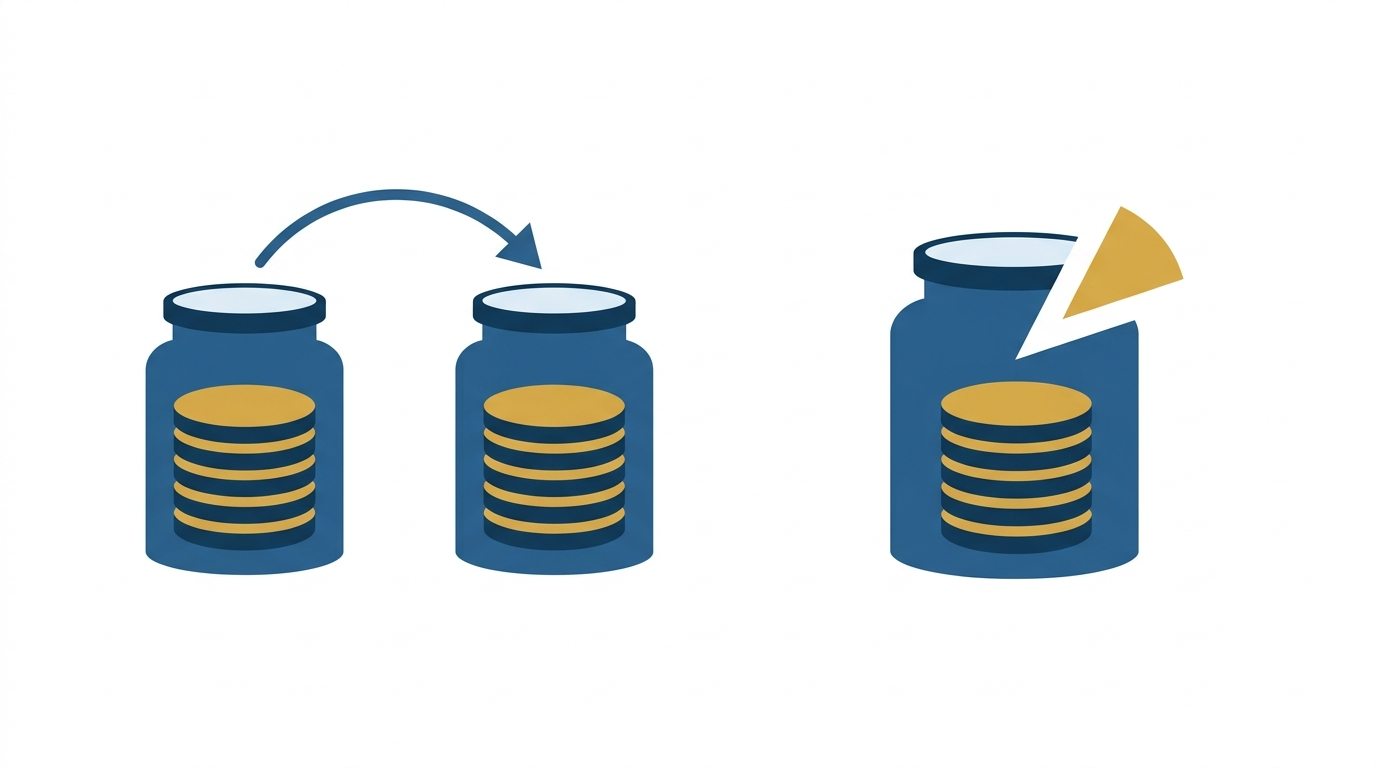
Here’s the core of the matter. When you redeem units in an investment fund and put that money into subscribing to another fund, the capital gain or loss isn’t computed at that moment: the new fund inherits the acquisition value and date of the one you left. For tax purposes, it’s as if you’d never sold.1
This has a huge practical consequence. Imagine you have €20,000 in a global equity index fund and, three years later, decide to move that money into an emerging-market equity fund because you want to change your asset allocation. With a fund, that move is a transfer: you fill in an order, the money moves from one to the other, and the Tax Agency doesn’t show up anywhere until the day you actually redeem for good. With an ETF, that mechanism doesn’t exist: to move from one to the other you have to sell the first one (with its gain or loss already subject to tax that same year) and buy the second with whatever is left.
The same rule that grants this advantage also fixes the order in which units leave when you redeem or transfer only part of your position: you’re deemed to sell the units you bought first (the FIFO rule, “first in, first out”), not the ones that would be most convenient for you to sell for tax reasons.1 It isn’t your choice which units you “sell”: the purchase date decides it.
The condition almost nobody checks
This is where most articles on the topic fall short, and where it really pays to pay attention if you invest in index funds tracking international indices (the vast majority of the ones sold in Spain come from fund managers domiciled in Luxembourg or Ireland).
The tax-free transfer advantage doesn’t apply to a fund just because it’s a fund. For a foreign collective investment scheme, the law requires two things at the same time:
- That it’s a UCITS-harmonised scheme, constituted and domiciled in an EU member state, and registered in the CNMV’s special register for marketing in Spain.
- That the purchase, subscription, transfer, and redemption are all carried out through an entity that is itself registered as a distributor with the CNMV.2
The first point is usually taken for granted, and rightly so: the big index funds sold in Spain meet that requirement. The second is the one almost nobody checks, and it’s not a minor formality: Spain’s securities regulator (the CNMV) has stated, at the request of the Directorate-General for Taxation itself, that the distributor’s role isn’t secondary. It acts as the main, necessary, and exclusive intermediary for all operations involving those units, and the investor cannot deal with them through any other entity. And that requirement doesn’t just cover the transfer: it also covers the original purchase of the units.3
In practice, this means that if you buy the same index fund through a platform or broker that isn’t itself registered as a distributor of that specific fund with the CNMV (something that can happen with certain investment apps operating in Spain from abroad, without being registered to market that particular scheme), you might hold “a fund” in your portfolio and, at the same time, not have the tax deferral you assumed you had. The rules governing transfers between funds are blunt about what happens then: as soon as the fund (or the channel through which you hold it) stops meeting the requirements for the deferral regime, any transfer order you give is treated, for tax purposes, as a plain redemption order.4 In other words: you’re taxed exactly as if you’d sold.
That same check (is my broker registered as a distributor of this fund with the CNMV?) also decides whether your foreign funds or ETFs trigger the modelo 720 reporting obligation: if it isn’t, you don’t just lose the deferral, you may also need to report those positions as assets held abroad.
And there’s a third edge to the same article worth keeping in mind: even if an index ETF tracks exactly the same index as the fund, the law expressly excludes listed funds and listed variable-capital investment companies (ETFs, whatever their legal form) from this advantage.2 It isn’t a gap you can close by picking a better broker: by legal definition, the ETF never has the deferral, no matter who sells it to you.
And the day you finally sell: the withholding one carries and the other doesn’t
There’s a second difference, smaller in money terms but noticeable day to day: when you redeem a fund at a gain, the management company applies a 19% withholding that’s paid directly on account of your tax return.5 When you sell an ETF at a gain, on the other hand, that withholding doesn’t exist: the regulation expressly excludes listed funds and companies from it.6
This doesn’t change how much you end up paying (both are taxed in the savings tax base, at the same progressive rates; we explain that in detail in how your investments are taxed in Spain), but it does change when you feel it. If you sell an ETF in December with a significant gain, you get the full amount and have to remember yourself to set aside what you’ll owe the Tax Agency come June. With a fund, that cushion is already deducted for you.
So which one should you choose?
There’s no single answer, but there is a clear way to decide based on how you invest:
- If you’re going to rebalance your portfolio over time (shift weights between regions, reduce risk as a goal approaches, exit a position when the time comes), the fund (chosen carefully, meeting the condition above) lets you do it without generating a tax bill at every intermediate move. You’re only taxed when you actually take the money out.
- If you’re going to buy a single exposure and leave it untouched for years (“buy and forget”), the transfer advantage barely gets used, and other factors can matter more: the management fee (some ETFs charge a bit less than their fund equivalent) or being able to buy and sell at any point during the session instead of waiting for the day’s net asset value.
- If you’re buying through a platform you don’t know well, before assuming you have the fund’s advantage, check that it meets the condition. It’s the part almost everyone skips, and it’s the one that decides whether you actually have the deferral or not.
Before assuming you have the deferral: the two-minute check
Three questions, in this order:
- Is the fund a UCITS-harmonised scheme, domiciled in the EU? For the big index funds tracking global indices, usually yes.
- Is it registered in the CNMV’s special register for marketing in Spain? You can check this in the CNMV’s own public register.
- Does the entity where you hold your account (bank, broker, robo-advisor) itself appear as a registered distributor of that specific fund, or does it operate through one that is? If you’re not sure, ask directly: it’s a fair question, and any serious entity should be able to answer it.
If any of these comes back without a clear yes, you weren’t taking for granted an advantage you didn’t have: better to know it before transferring than to find out during a tax review.
How Cuéntamo helps with this
The investment module in Cuéntamo Más records every transaction (buy, sell, transfer) exactly as it happened, and automatically applies FIFO order when calculating which units leave first when you sell only part of your position, exactly the criterion the law requires. The gain or loss on each sale is calculated to the cent, and if you sell at a loss, Cuéntamo carries that balance forward to offset it against gains in the next four tax years without you having to keep track yourself.
For your tax return, the tax panel gives you a CSV export with capital gains and losses already separated from returns on movable capital (dividends, coupons), with the balance to offset from previous years already applied. If you also bring in your broker’s history (DeGiro, Trade Republic), you import it with its CSV and Cuéntamo reconstructs the FIFO lots from your first purchase.
If you’re still not sure where to start building that portfolio, how to start investing from scratch walks through the basic products one by one, and once you have activity in your portfolio, how your investments are taxed in Spain fills in the rest of the tax map: dividends, pension plans, and what happens if you hold assets abroad.
Frequently asked questions
Are an index ETF and an index fund tracking the same index taxed the same in Spain?
They’re alike in how much you pay when you sell at a gain (the same progressive savings-base rates), but not in when. The fund lets you transfer into another fund without being taxed at the moment of the switch; the ETF has no such mechanism, so every sale generates a gain or loss taxed that same year.
Do all index funds have the tax-free transfer advantage?
Not by default. For a foreign fund, it needs to be a UCITS-harmonised scheme registered in the CNMV’s special register, and the purchase, transfer, and redemption all need to go through an entity that is itself registered as a distributor with the CNMV. If that last part isn’t met, you lose the deferral even if the fund itself is fine.
Why do I get withheld tax when redeeming a fund but not when selling an ETF?
It’s a difference in the IRPF regulation: it applies a 19% withholding to fund redemptions, and expressly excludes listed funds and companies (ETFs) from that withholding. It doesn’t change how much you pay overall, only whether part of it is paid in advance or you have to set it aside yourself.
Is the fund or the ETF better if I’m going to buy and hold for years without touching it?
If you’re not going to transfer or rebalance, the fund’s deferral advantage barely shows up, and other factors (management fee, being able to buy and sell any time during the day) can matter more. The fund’s advantage shows up when you move your investment around several times over the years.
How do I check if my broker is a registered distributor with the CNMV?
You can check the CNMV’s public register or ask the entity directly. The fund being properly registered isn’t enough: if the entity you operate through isn’t itself registered as a distributor of that fund, you probably don’t have the deferral even though you hold “a fund.”
This article is purely informational. It is not tax or investment advice: before transferring or redeeming a significant amount, check your specific situation against the fund’s prospectus, with your broker, or with an adviser.
The deferral regime under Article 94 of the IRPF Law and the withholding rules under Article 75 of its Regulation have been in force, in essence, since 2003 (with a change introduced by Law 11/2021, in force since 1 January 2022, that clarified the registered-distributor requirement), so they don’t depend on the current tax year; what’s worth checking case by case is whether your specific fund and broker meet that condition. This article is checked against official sources and reviewed periodically. If you spot anything out of date, email us at [email protected].
Article 94.1.a) of Spain’s Personal Income Tax Law (Ley 35/2006, IRPF): “when there are homogeneous securities, those transferred or redeemed by the taxpayer shall be deemed to be those acquired first” and “when the amount obtained as a result of the redemption or transfer of units or shares in collective investment schemes is used (…) to acquire or subscribe other units or shares in collective investment schemes, the capital gain or loss shall not be computed, and the newly subscribed units or shares shall retain the value and acquisition date of the units or shares transferred or redeemed.” ↩︎ ↩︎
Article 94.2.a) of the Personal Income Tax Law (Ley 35/2006, IRPF): the deferral regime applies to schemes “regulated by Directive 2009/65/EC (…) constituted and domiciled in an EU member state and registered in the special register of the Spanish Securities Market Commission (CNMV),” further requiring that “the acquisition, subscription, transfer, and redemption of shares and units (…) shall be carried out through distributing entities registered with the Spanish Securities Market Commission,” and excluding the regime when the transaction “concerns units representing the assets of collective investment schemes (…) that qualify as listed investment funds or shares of companies of the same type under Article 79 of the regulation implementing Law 35/2003” (that is, ETFs). ↩︎ ↩︎
Binding ruling of Spain’s Directorate-General for Taxation (DGT) V0070-22, of 18 January 2022, which cites the CNMV’s report on the scope of Article 94.2.a).1º of the IRPF Law: “the distributor must act as the main, necessary, and exclusive intermediary in all operations relating to the scheme (subscription, redemption, and transfer), with the investor unable to deal with their investments through any other entity.” The same ruling adds that this requirement “must be understood to refer both to operations linked to the transfer of the investment and to the original acquisition of the shares or units.” ↩︎
Binding ruling of Spain’s Directorate-General for Taxation (DGT) V0070-22, of 18 January 2022, on the operating procedure described in the distribution agreement under review: “From the moment a collective investment scheme ceases to be eligible for the reinvestment deferral regime, any transfer orders shall be treated as plain redemption orders.” ↩︎
Article 75.1.d) of the Personal Income Tax Regulation (Real Decreto 439/2007): subject to withholding are “those [gains] obtained as a result of transfers or redemptions of shares and units representing the capital or assets of collective investment schemes.” The 19% withholding rate for capital income is set by Article 101.6 of the Personal Income Tax Law (Ley 35/2006, IRPF). ↩︎
Article 75.3.j).1.º of the Personal Income Tax Regulation (Real Decreto 439/2007): there is no obligation to withhold on “capital gains derived from the redemption or transfer of units or shares issued by (…) listed investment funds and listed index variable-capital investment companies regulated by Article 79 of the regulation implementing Law 35/2003.” ↩︎