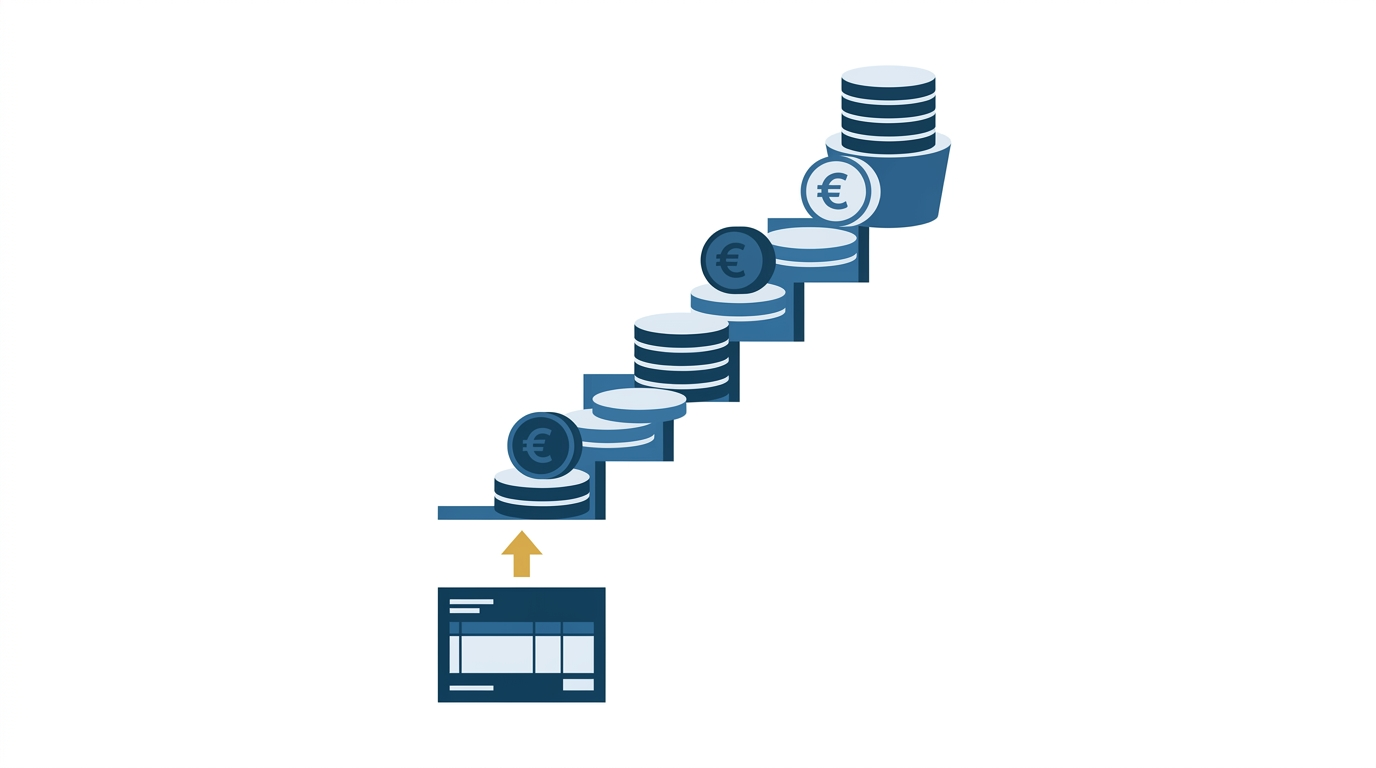
Raise your savings every time you get a raise
You get a raise, and a few months later you’re living exactly as tight as before it. Nothing strange happened: you changed cars, eat out a bit more, the flat is “nicer” now. Each new expense made sense on its own. The problem is that, added up, they swallowed the whole raise, and your savings are still the same number as before.
The tip: raise your savings, not your spending
It’s called lifestyle inflation: the more you earn, the more you spend, in the same proportion, without ever deciding it consciously. It’s not a character flaw — it’s what happens by default if you don’t do anything: the new money lands in the same account as always and quietly splits itself among things you were already itching to upgrade.
The rule that cuts it off is a single move: the same day your raise lands, you also raise the amount you save automatically, by at least half of the increase. If you’re getting €100 more a month, €50 (or more) goes straight into savings before it ever reaches your day-to-day account. You live on the rest, which is still more than you had before, so you keep feeling the improvement without letting it get swallowed whole.
It doesn’t have to be 100% of the raise — that’s unsustainable and you’ll end up reversing it the first slow month. Half is enough for your savings to grow every time your salary does, instead of staying frozen while only spending goes up.
An example with numbers
Say you earn €1,800 a month and save €100 (5.5%). You get a raise to €2,000, a €200 increase. Left alone, that money splits itself up on its own: a bit more going out, a bit more eating out, maybe a new subscription. A few months later you’re still saving that same €100, even though you’re earning €200 more than before.
Applying the rule, the same month the raise lands you set up an additional automatic transfer of €100 (half of the €200). Now you save €200 a month instead of €100, and you live on €1,800 of available spending instead of €1,700: you notice the raise — €100 more of breathing room every month — and your savings have doubled.
The difference shows over a year: with the first option you’re still saving €1,200 a year, exactly the same as before the raise. With the second, you save €2,400, double, without having given up enjoying part of the increase. And if you repeat the move on every future raise — from your salary, a new client, whatever it is — your savings climb step by step while spending grows more slowly, which is the opposite of what happens if you do nothing.
How to apply it today
Three steps, and the moment to do it is the same day you see the raise on your payslip, not “whenever you get a moment”:
- Work out half the raise in euros. No need for more precision than that: if it’s €150 more a month, half is €75.
- Set up a new automatic transfer, or raise the one you already have, by that amount, on the same day you get paid.
- Repeat the move on every future raise, even a small one. The habit matters more than the amount: skipping one annual review is enough to break the habit entirely.
If you’ve never automated your savings before, start there before applying this rule: pay yourself first covers that first step with its own numeric example.
How does Cuéntamo help with this?
Cuéntamo doesn’t bump the transfer for you — that’s something you set up with your bank — but it does let you see whether the habit holds up over time: with a savings goal you set the figure you want to reach and see whether the actual pace, month by month, holds steady or fades after each raise. And in the balance forecast you can check, before spending the raise on something new, whether that extra fixed expense really fits with the rest of the month.
The money that starts piling up every time your salary rises is also the money that benefits most, over the years, from being left to work on its own: compound interest explained with real examples shows why starting earlier matters more than contributing more later. And if your emergency fund is already covered and you’re wondering where to put that growing pile of savings, how to start investing from scratch has a simple plan organized by time horizon.
You can try it for free at cuentamo.com.
Frequently asked questions
What if I need the whole raise just to make it to the end of the month?
Then this rule can wait: there’s no point forcing savings that leave you short on the basics. But it’s worth checking why the entire raise is already spoken for before it even lands — if fixed expenses rose right along with your salary, it’s worth a closer look before the next raise, not after.
Why half and not the whole raise?
Because 100% tends not to last: the first slow month, the feeling of “I’m exactly where I was before the raise” weighs on you and you end up reversing the transfer. With half you feel the improvement in day-to-day life — which helps the habit stick — and your savings still grow every time your salary does.
Does this also work if the increase isn’t from a payslip, but from a new client or a one-off extra payment?
The principle is the same, though the automation needs adapting: if the income is recurring (a steady client, a stable raise), set up the transfer just like with a payslip. If it’s a one-off (a bonus, an extra payment), apply the same proportion once instead of scheduling it monthly.
This article is checked against official sources and reviewed periodically. If you spot something outdated, write to us at [email protected].