The VAT you paid on business expenses in the EU — Spain can get it back for you, but only until September 30
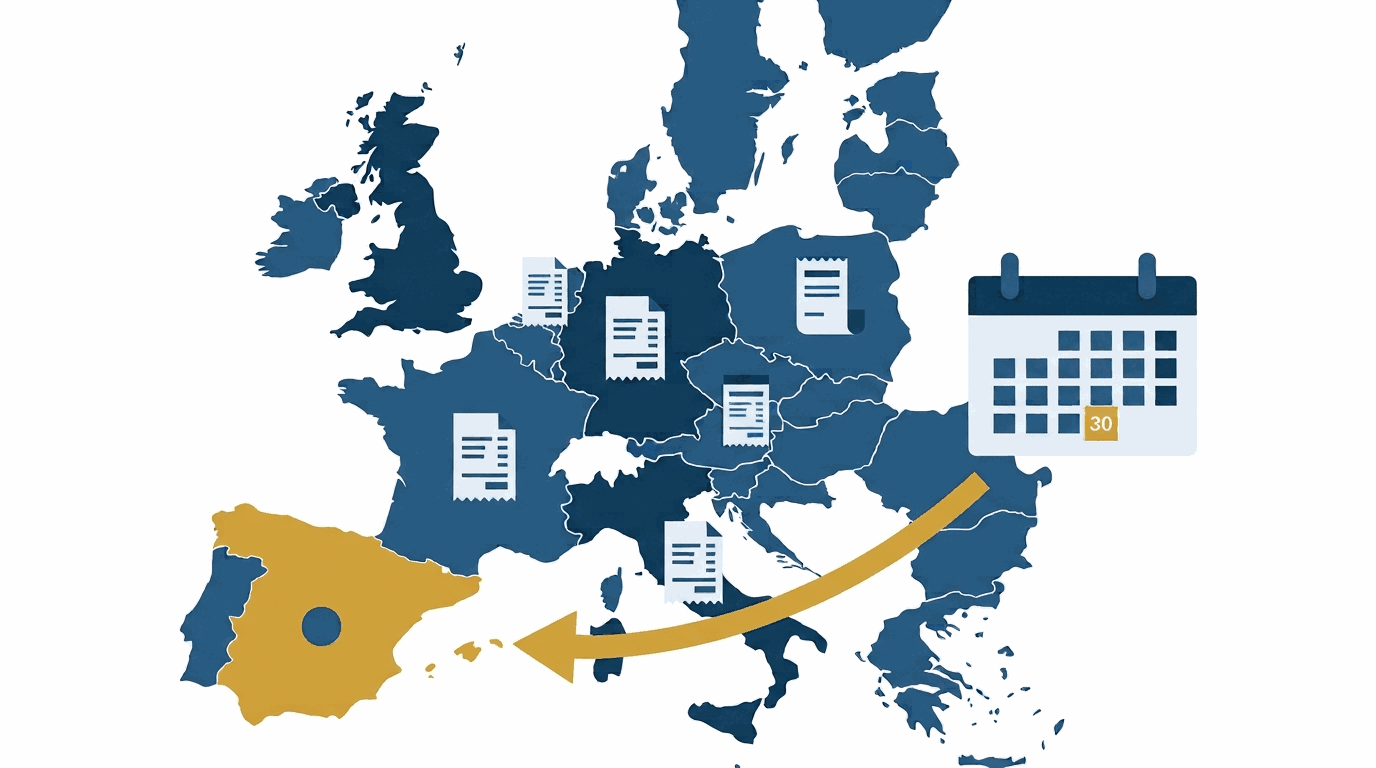
Say you went to a trade fair in Germany last year. You paid for the hotel, the food, the fuel on the way there, and the entry fee — all with invoices you kept. Hidden inside those invoices is German VAT (Mehrwertsteuer, their equivalent of IVA) that you are legally entitled to claim back. But there is a deadline to do it, and it falls on September 30.
The same applies to the conference in Paris, the client visit in Lisbon, the accommodation in Milan, or the Italian motorway tolls. If you are self-employed and you had business expenses in EU countries last year, there is a refund you may be owed — and most people who qualify never ask for it.
The mechanism is called modelo 360, it has existed for years, and it is entirely legitimate. The problem is that it flies so far under the radar that a significant share of those who could benefit simply do not bother.
What VAT can you reclaim
The rule is straightforward: if you incurred VAT on business-related expenses in another EU member state, and that same expense would give you a right of deduction if you had incurred it in Spain, you can ask that country’s tax authority to refund you the VAT you paid.
The expenses that most commonly generate this entitlement are:1
- Fuel for vehicles used in your business activity
- Vehicle rental (cars, vans)
- Tolls and public transport
- Accommodation (hotels, apartments)
- Meals and restaurants (with caveats depending on the country — see below)
- Trade fairs, exhibitions, and conferences
- Certain professional services
The VAT you reclaim is not Spanish VAT: it is the equivalent tax charged in that other country, at that country’s rate and under that country’s rules.
The nuance that varies by destination
This is the part that confuses most people. Whether you have a right to the refund does not depend on Spanish rules — it depends on the rules of the country where you incurred the expense.
Each EU member state may restrict the categories of deductible expenses for non-resident claimants, and it does so according to its own criteria — sometimes against you, sometimes in your favour. Germany, for instance, allows full deduction of the VAT on business meals, even on the portion that is not deductible there for income tax purposes:2 it is more generous than Spain. France, by contrast, allows no deduction at all on the VAT of a passenger car, and caps fuel at 80%.3 The key point is that the deductibility of an expense is determined by the country where you paid it, not by the Spanish Tax Agency. So an expense that would be trimmed here may come back in full there, and the other way round.
What the AEAT does is act as an intermediary: you file modelo 360 through the Spanish electronic Tax Office portal, and it forwards your request to the tax authority of the relevant country. If you had expenses in three different countries, you need a separate request for each one (though they can all be included in a single form submission).
Why September 30 is a cut-off, not a prescription deadline
This distinction matters enormously. A cut-off (plazo de caducidad) does not work like a prescription deadline (prescripción): it is not interrupted, it does not pause, it offers no second chances. If October 1 arrives and you have not filed modelo 360 for your previous year’s expenses, that entitlement disappears permanently.4
Prescription, by contrast, is the four-year window during which the tax authority can come after you. That window does admit interruptions. But for the refund of VAT paid in other EU countries, the regulation sets a hard cut-off date: every September 30, for expenses from the previous year.
There is no extension and no second chance.
Minimum amounts and when it is worth the effort
There is a minimum amount required to file the annual claim: 50 euros. If the sum of VAT you want to reclaim from a particular country does not reach that threshold, you cannot file a claim for that year and that country.5
If you had one-off expenses in different countries during the previous year — a conference here, a trade fair there — the most common approach is to bundle everything from the same country into a single annual claim. The more invoices you have, the more likely you are to clear the minimum.
Standard VAT rates across the EU run from Luxembourg’s 17% to Hungary’s 27%, and almost every country also applies reduced rates to things like accommodation. It is worth checking the actual rate on each invoice, because it is not the same for everything.
A two-day trade fair in Germany, with German rates:6
- Hotel, three nights at 250 euros: 750 euros at 7% (accommodation takes the reduced rate) → 52.50 euros of VAT
- Fair registration, 400 euros at 19% → 76 euros
- Rental car and fuel, 300 euros at 19% → 57 euros
That is 185.50 euros. Note that the hotel on its own barely clears the 50-euro minimum: what makes the claim worth filing is adding up the whole trip. That is real money — and if you do not ask for it, it simply does not come back.
What you need to file the claim
The requirements are the standard ones for any transaction with the AEAT:7
- Digital certificate or Cl@ve to access the electronic Tax Office portal
- The invoice details, plus an electronic copy of any invoice with a taxable amount above 1,000 euros (or 250 euros for fuel): in those cases attaching it is not optional, it is mandatory8
- Bank account details for the refund (a Spanish account works fine)
- Period: expenses incurred between 1 January and 31 December of the previous year
You submit everything through the VAT section of the AEAT’s electronic portal using modelo 360. The Spanish Tax Agency then sends your request on to the relevant country — you do not have to contact each foreign tax authority yourself.
Who this applies to
This mechanism applies exclusively to expenses linked to your business activity — not holiday trips. But if any of the following situations apply to you with expenses from last year, it is worth adding up the numbers before September 30:
- You attended a trade fair, conference, or professional event in Europe
- You visited clients or suppliers in another EU country
- You rented a vehicle or drove to a European destination by car for work
- You stayed overnight abroad in connection with a project or engagement
If you are unsure whether a specific expense qualifies, the conservative approach is to include it in the claim and let the other country’s administration decide. The one thing you cannot afford to do is request nothing at all and lose the entitlement.
The place where your invoices are already on record
If you manage your business finances in Cuéntamo, your business expenses from the previous year are already logged with their dates, amounts, and VAT. You can filter by account, category, or date to find your EU business-travel expenses, and see at a glance the VAT you incurred in each country — which makes gathering the documentation for the claim considerably faster.
Try it free at cuentamo.com.
Frequently asked questions
Does modelo 360 apply only to the self-employed, or also to companies?
It applies to any business or professional established in Spain (or in the Canary Islands, Ceuta or Melilla) who incurred VAT on business expenses in another EU member state. Both self-employed individuals and corporate entities can file it.
Can I file modelo 360 if I had expenses in multiple countries?
Yes. You can include claims for different countries within the same modelo 360 filing. Each country will have its own resolution process, but the submission is a single transaction with the Spanish Tax Agency.
What happens if I do not reach the 50-euro minimum?
You cannot file a claim for that country for that year, and the amount does not carry forward to the next year — it is simply lost. If you are close to the threshold, it is worth checking whether there are any invoices you may have overlooked.
How long does the refund take?
The timelines are set by each member state. European rules require a decision within four months of receipt of the complete claim, with the possibility of asking for additional documentation. In practice, turnaround times vary considerably by country.
Does the refunded VAT count as income in Spain?
No. It is a recovery of a tax you already paid, not new income. In accounting terms, it reduces the cost of the expense it was associated with.
This article explains the general mechanism; it doesn’t replace advice from a tax advisor if your specific case is unclear or if you’ve already received a formal request.
This article is checked against official sources and reviewed periodically. If you spot something outdated, write to us at [email protected].
The list of eligible expenses is established in Council Directive 2008/9/EC of 12 February 2008, which harmonises the VAT refund procedure across EU member states (a recast of the Eighth VAT Directive). Each member state may apply restrictions to the categories of deductible expenses in the same way as it restricts deductions for its own taxable persons. ↩︎
In Germany the input VAT on business meals (Bewirtungskosten) is fully deductible under §15 of the Umsatzsteuergesetz, including on the 30% of the expense that is not deductible for income tax purposes. They are two separate systems, and it is a mistake to read them through the Spanish rule. ↩︎
In France the VAT on passenger vehicles (véhicules de tourisme) is not deductible at all, and fuel VAT is deductible at 80% for those vehicles and 100% for commercial ones. ↩︎
The deadline is set out in Article 15 of Directive 2008/9/EC: “The refund application shall be submitted to the Member State of establishment at the latest on 30 September of the calendar year following the refund period.” That it is a forfeiture deadline, and not a limitation period, was settled by the Court of Justice of the European Union in Elsacom (Case C-294/11, 21 June 2012), a criterion the Spanish courts apply consistently: file late and the right to the refund is gone. The Spanish implementing regulation is Orden EHA/789/2010, of 16 March — whose Article 4 sets out the same deadline — as amended by Orden HAC/498/2024, of 21 May, which changed its Article 8 and replaced Annex II with effect from 1 July 2024. ↩︎
Minimum amounts are set out in Article 17 of Directive 2008/9/EC: if the refund application covers a period of a full calendar year (or the remaining part of a year), the amount may not be less than 50 euros; if it covers a period of between three and eleven months, the amount may not be less than 400 euros. ↩︎
German rates in force: a standard rate of 19% and a reduced rate of 7%, the latter applying to hotel accommodation (breakfast and other services the hotel invoices separately take the standard rate). Since 1 January 2026 Germany also applies the 7% rate to restaurant services, excluding beverages. The figures in the example are taxable amounts. ↩︎
Modelo 360 and the submission guide are available at the Spanish Tax Agency’s electronic portal. ↩︎
Article 10 of Directive 2008/9/EC and Article 5.1.a of Orden EHA/789/2010: an electronic copy of the invoice must be attached where its taxable amount exceeds 1,000 euros in general, or 250 euros in the case of fuel. ↩︎