The three-account system that stops you thinking about money
You check your account balance before buying something that isn’t essential. The number looks big enough, so you buy it. Ten days later the building maintenance fee hits and throws off your whole month, because that “big enough” number was already spoken for without you knowing it. It’s not that you’re spending badly: it’s that a single number doesn’t tell you which part is actually yours to spend.
The tip: let your money live split up, not together
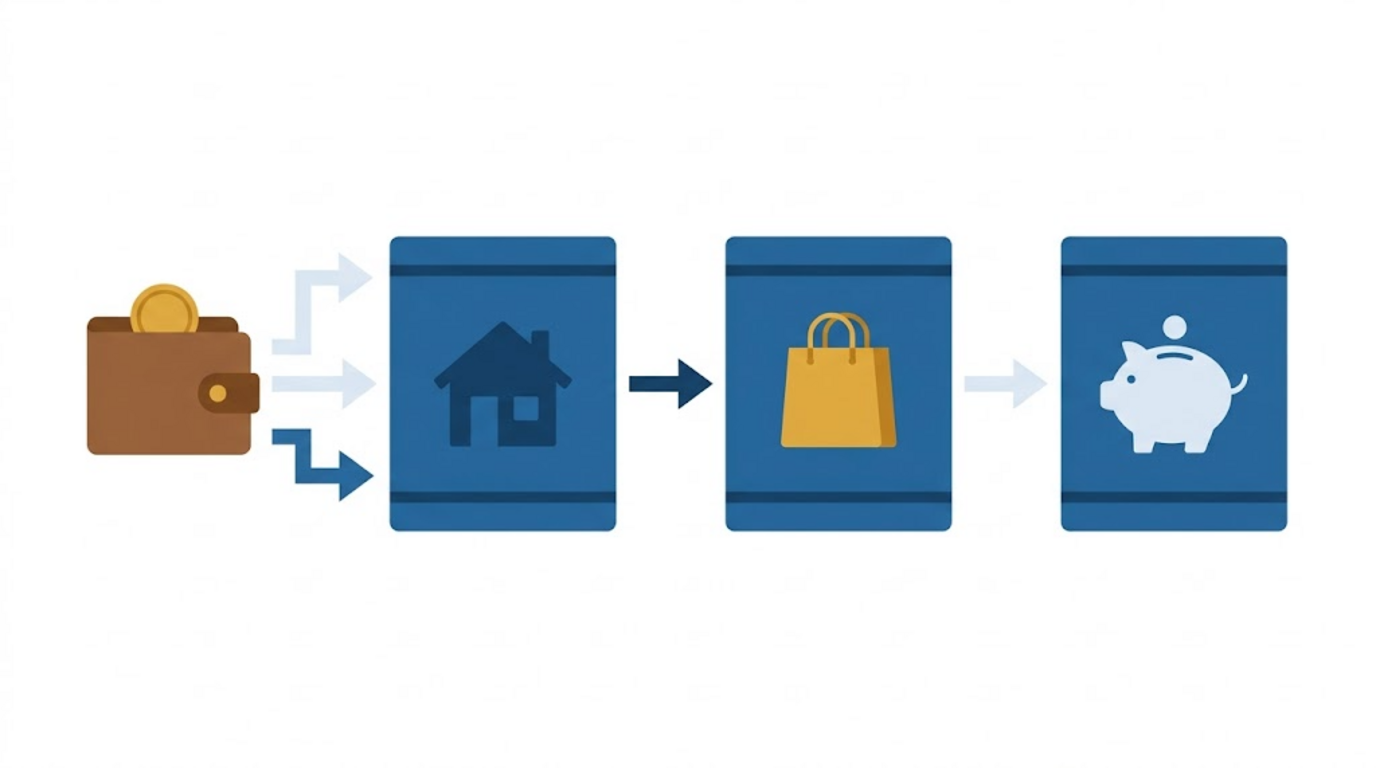
The idea is simple and doesn’t depend on doing any mental accounting: split your money into three physical accounts, each with one job.
- Fixed-costs account. The day you get paid, this is where exactly what you need for rent or mortgage, bills, and subscriptions goes in. You don’t touch it for anything else: it’s the account everything gets direct-debited from.
- Day-to-day account. Whatever’s left after setting aside fixed costs and savings. This is where your grocery card, gas, and weekend plans live. Everything in there is yours to spend guilt-free, because everything else is already safe.
- Savings account. Separate, with no card handy and not checked every week. This is where your emergency fund or any other goal grows, and the rule is: don’t touch it unless it’s a real emergency.
The trick isn’t discipline: it’s that you stop needing it. When you check the balance of your day-to-day account, that figure is already your real limit, not a number you still have to mentally subtract from. If it’s there, it’s yours to spend; if it isn’t, it isn’t.
An example with numbers
Say you’re paid €1,800 a month. You go through your bills — we cover how to do this properly in recurring household expenses — and they add up to €900 between rent, electricity, insurance, gym, and subscriptions. You decide to set aside €150 a month toward your emergency fund. The split looks like this:
- Fixed-costs account: €900, paid automatically by direct debit.
- Savings account: €150, transferred automatically on payday.
- Day-to-day account: the remaining €750, to spend without further math.
With everything mixed in a single account, that same €1,800 balance on day one looks like a lot more room than you actually have: you’re left with “only” €750 free, but without splitting it, it’s easy to dip into the €900 that already had an owner. The split doesn’t change how much you earn or spend: it changes the fact that the number you see every day is already the answer, not a pending calculation.
And if something inside that €750 always gets away from you (going out, gifts), you can split it further with the envelope method, in digital form.
How to apply it today
You don’t need to set it all up at once or switch banks:
- Open a second account if you don’t already have one. Most banks and apps offer free additional accounts; you don’t need to sign up for anything with fees.
- Add up your real fixed costs, not a rough guess: bills, subscriptions, instalments. If you’ve never listed them all together, that first review usually turns up a surprise (a forgotten subscription, an insurance premium that went up without you noticing).
- Schedule two automatic transfers on payday: one to the fixed-costs account for the total you calculated, another to the savings account for whatever amount you’ve decided to set aside. What’s left in your main account is, from then on, your day-to-day money.
- Don’t open the savings account just to look at it. The less you see it, the less tempted you’ll be to touch it. If your bank lets you name it or attach a goal (like “emergency fund”), even better: seeing it labelled reinforces that the money already has a purpose.
How does Cuéntamo help with this?
Cuéntamo doesn’t replace the automatic transfers your bank sets up, but it does solve the part that gets lost when your money is split across several accounts: seeing it all together. Add your three accounts, and the app shows you the balance of each one plus the total, so you keep the full picture without losing the separation. And with the balance forecast, you can check — before the big quarterly bill arrives — whether what you set aside in the fixed-costs account is going to be enough, or whether it’s time to adjust the split.
You can try it for free at cuentamo.com.
Frequently asked questions
What if some months my fixed costs vary (electricity, gas) and what I set aside isn’t enough?
Set aside a bit above the average, not the exact minimum of your cheapest month. If some months there’s a surplus, it stays in the fixed-costs account as a cushion for the month the bill goes up; you don’t need to recalculate every time.
Isn’t checking three accounts more hassle than checking one?
It takes a little getting used to at first, but in exchange you stop having to do mental math every time you’re about to buy something. An app that shows you the balance of all three together (like Cuéntamo) removes exactly that uncomfortable part of having your money split up.
How much should I set aside in the savings account each month?
Start with whatever you can manage without straining, even if it’s just €50, and raise it when you can: what matters is that the transfer is automatic from the first month, not the exact figure you start with.
Does the tax office mind if I have several accounts? Is there a limit?
No, and there’s no limit: you can have as many accounts as you like, at one bank or several, and if they’re Spanish banks you don’t have to report anything. The Spanish Tax Agency already knows about them. Since January 2026, banks report every month which accounts are open and who their holders and authorised users are, and once a year the balance at 31 December, the average balance for the last quarter and the total debits and credits (that’s form 196). Moving money from one of your accounts to another of yours isn’t income and isn’t taxed. The only thing that goes on your tax return is interest, if any of the accounts pays it: it counts as income from movable capital and is taxed in the savings base.
What if I forget about the savings account for years?
Not looking at it is the idea; forgetting it altogether isn’t. If twenty years go by without you doing anything with it that shows it’s yours, Spanish law treats it as abandoned and the balance goes to the State. Twenty years is a lot of leeway, but that’s exactly what happens to “don’t touch” accounts left at a bank you no longer use. Keep it in view alongside the other two, even if you never open it, and it won’t get lost.
Figures as of 2026. What banks report to the Spanish Tax Agency about your accounts is governed by Order HAC/747/2025 (form 196, monthly since January 2026). Interest is taxed in the savings base under articles 25.2 and 46 of the Personal Income Tax Act, and the twenty-year abandonment period is the one in article 18 of Law 33/2003 on Public Administration Assets.
This article is checked against official sources and reviewed periodically. If you spot something outdated, write to us at [email protected].