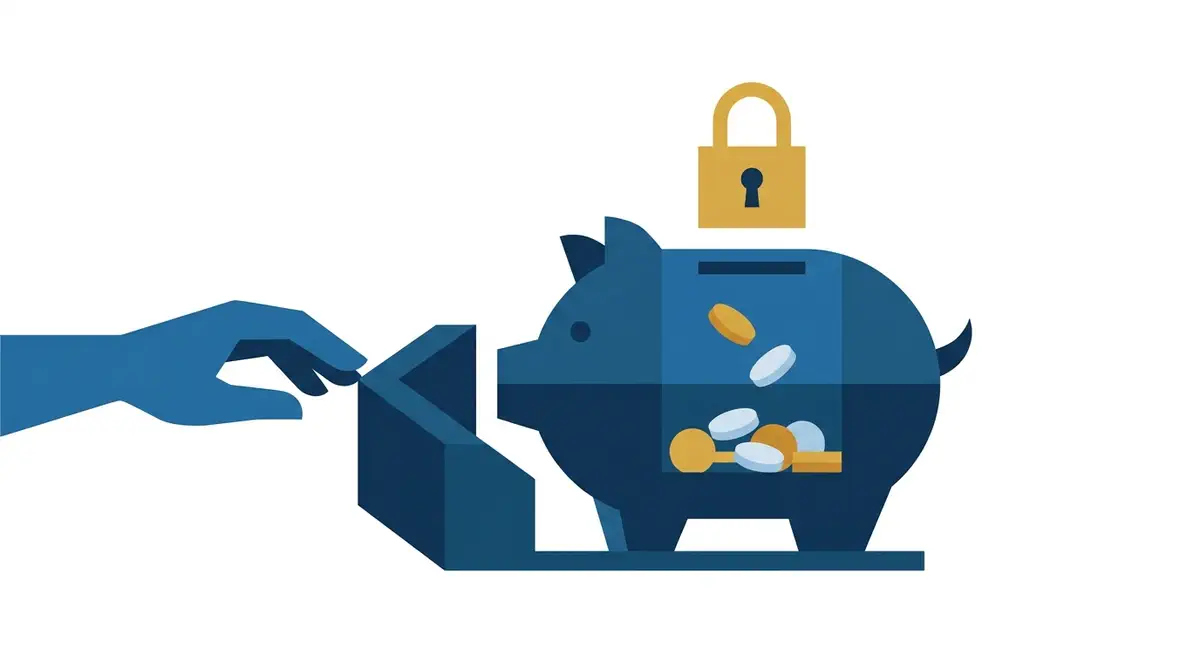
The 'don't touch' account: add deliberate friction to your savings
You have a savings fund, you know you’re not supposed to touch it, and you touch it anyway. Not because you lack discipline: because it’s two taps away, in the same app where you check your everyday account balance. Any Friday-night craving finds that money with zero effort.
The tip: make withdrawing it cost something
The fix isn’t more willpower, it’s less convenience. Put deliberate friction between you and that money, so there’s a real obstacle between the impulse and the transfer, not just a good intention. Three levels, from least to most friction:
- A different account, same bank. No card attached and, if your bank allows it, hidden from the app’s home screen. It’s the minimum friction: still two taps away, but at least you don’t see it every time you check your balance.
- A different bank. No one-click access from your usual banking app: you have to log into another website, with another username and another password. The money is still yours and still available, but it’s no longer within reach when your guard is down.
- A term deposit. The money is committed until maturity and, depending on each deposit’s terms, taking it out early costs you part of the interest or simply isn’t allowed. This is the highest friction level: the money doesn’t disappear, but you can no longer pull it out today on an impulse.
You don’t have to pick just one. It’s common to combine them: the full emergency fund at level 2 or 3, and a small true-emergency cushion (a flat tyre, a dentist visit) at minimum friction so you’re not stuck if you genuinely need cash fast.
An example with numbers
Say you have a €4,500 emergency fund, the result of applying three months of spending to your €1,500 monthly expenses. If that money sits in the same account where your paycheck lands and you pay with your card, a €300 impulse buy during a sale disappears in the time it takes to open the app and tap “transfer.” What’s left of the fund, €4,200, is still there, but it’s already dropped once without any real emergency involved.
If that same fund lives in a different bank, with no card and no app installed on your phone, the path to pulling out that €300 is no longer an automatic gesture: you have to log into another banking site, remember another password, and confirm with a code. It’s not impossible, but it’s no longer effort-free. That small inconvenience is exactly the time the 24-hour rule needs to do its job: if the next day you still want that €300, you withdraw it with a clear head; if not, it stays put.
How to apply it today
You don’t need to set it all up at once:
- Pick the friction level based on how hard it is for you to resist. If you never touch your savings, a separate account at your own bank is enough. If you catch yourself dipping into the fund more than once a quarter, go straight to the different bank or the term deposit.
- Transfer the whole fund at once, not little by little. One big, already-done transfer weighs less on your mind than “sacrificing” a bit of it every week. And if you don’t already set savings aside automatically, pay yourself first on payday before worrying about where to keep it.
- Remove the quick access. Delete that bank’s app from your phone if you don’t need it for anything else, and turn off fingerprint or short-PIN login if it’s on by default.
- Give it a name that reminds you of the goal. If your bank lets you label the account or the savings pot (“emergency fund,” “don’t touch until…”), do it: seeing it written down stops you more than a bare number.
How does Cuéntamo help with this?
Cuéntamo can’t lock your money away or switch your bank for you, but it does solve what gets lost when you spread your money across different places to gain friction: losing sight of the total. You add that account just like any other, even if it’s at a different bank, and you see it in your balance and your forecast alongside the rest, without making it any more accessible for an impulse buy. Friction to touch it, zero friction to see it.
You can try it for free at cuentamo.com.
Frequently asked questions
Isn’t it better to keep everything together so I can control it better?
Controlling it and being able to tap it in one click are different things. You can have it all under control — seeing it in a single app, like Cuéntamo — and still have withdrawing it require an extra step. The friction that matters here is on taking the money out, not on seeing it.
Don’t I lose returns by putting the money in an inconvenient account instead of investing it?
The emergency fund isn’t there for returns, it’s there to be available when you genuinely need it: its job is to not lose value and not disappear on a whim, not to earn you a percentage. If the account or deposit also pays some interest, great, but that’s a bonus, not the goal. For the part of your money that’s actually after long-term returns, the emergency fund isn’t the place: that discussion starts at how to start investing.
What if I have a real emergency and can’t get the money out in time?
With a different bank that’s not a problem: an instant transfer between banks arrives in seconds, and the friction lies in having to sit down and do it, not in waiting. The real risk is the term deposit, which you can’t cash out on the spot. That’s exactly why you shouldn’t max out the friction on everything: keep a small cushion (just enough for a genuinely immediate emergency) at minimum friction, and the rest of the fund at the more inconvenient level. That way you’re never without cash on the day the emergency is real, but you also don’t have the whole fund one tap away from a craving.
This article is checked against official sources and reviewed periodically. If you spot something outdated, write to us at [email protected].