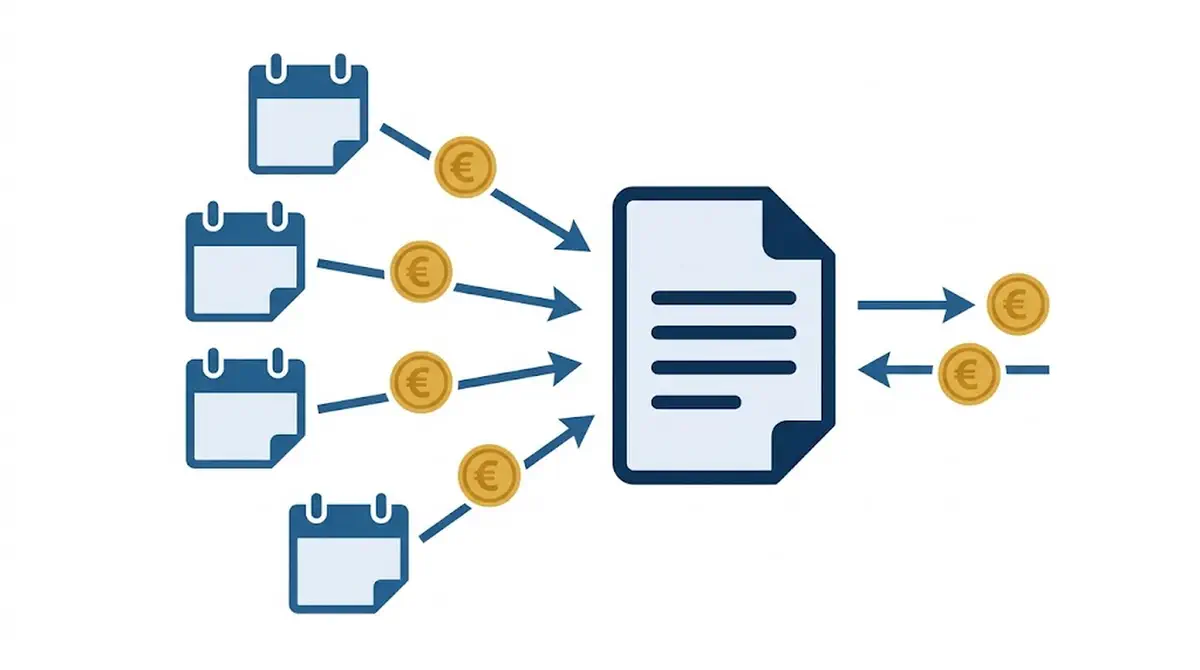
Does What You Pay Each Quarter in Modelo 130 Come Back in Your Tax Return? How the Two Cross, With Numbers
No. What you pay each quarter through modelo 130 (Spain’s quarterly income-tax prepayment for the self-employed) isn’t refunded on its own when your annual tax return (the Renta) comes around. It’s subtracted from what you owe in that return, together with the withholding tax (retenciones) your clients applied on your invoices.1 You only get back the part you overpaid. If you underpaid, you pay the difference then.
Put like that it sounds simple, and it is, but it doesn’t explain why the same mechanism gives some autónomos (self-employed workers) a refund and others a bill. The answer is in the numbers, so let’s go through a complete example: from what you pay quarter by quarter to what your return shows.
How the two cross
Modelo 130 isn’t a separate tax: it’s an advance on your own income tax (IRPF). Each quarter you prepay part of what you’ll probably owe for your business that year. When you file your tax return, the Spanish Tax Agency (Agencia Tributaria) works out the tax due on everything you earned in the year (the state share plus the regional share) and subtracts what you’ve already advanced: your modelo 130 payments and the withholding your clients applied. What’s left is called the cuota diferencial.1 If it’s positive, you pay. If it’s negative, you get the excess back.2
So the useful question isn’t “do I get modelo 130 back?” but “did what I advanced between modelo 130 and withholding fall short of, or overshoot, what I owed for the whole year?”
An example from start to finish
Meet Rubén, a self-employed illustrator under direct assessment (estimación directa) in common-regime territory. (Rubén is made up; the numbers are round so you can follow the maths.) He ends the year with net business income of €28,000 (income minus deductible expenses), and some of his invoices, the ones he issues to companies, carry 15% withholding.3
Modelo 130 in common-regime territory is cumulative: each quarter you take 20% of your net income since 1 January, and subtract the year’s withholding up to that quarter and what you should have paid in the previous quarters.4 Here’s how it looks for Rubén:
| Quarter | Cumulative net income | 20% of cumulative | Cumulative withholding | Earlier 130 payments | Due this quarter |
|---|---|---|---|---|---|
| Q1 | €6,000 | €1,200 | €300 | €0 | €900 |
| Q2 | €13,000 | €2,600 | €600 | €900 | €1,100 |
| Q3 | €20,000 | €4,000 | €900 | €2,000 | €1,100 |
| Q4 | €28,000 | €5,600 | €1,200 | €3,100 | €1,300 |
Across the four modelo 130 returns he paid 900 + 1,100 + 1,100 + 1,300 = €4,400. Add the withholding (€1,200) and his total advance comes to €5,600, which is no coincidence: it’s exactly 20% of the year’s €28,000. In a case like Rubén’s, with no reductions and less withholding than that 20%, modelo 130 plus withholding ends up adding to 20% of what he earned.
Now the tax return arrives. The general IRPF scale is applied to his income. The state share goes from 9.5% on the first €12,450 to 15% on what’s above €20,200, and keeps rising in bands; from that you subtract what would correspond to his personal and family allowance, which isn’t taxed.5 The regional share works the same way, with his region’s scale. If you want your own figure rather than an example, the IRPF simulator applies your regional scale and personal situation.
Look at what happens with two different tax bills on the same €5,600 advance:
Rubén, with two children. The family allowance rises with each child, and that slice of income isn’t taxed. Suppose that with it his final tax (state plus regional) comes to €4,200: 4,200 − 5,600 = −€1,400. The Tax Agency refunds him €1,400, because he advanced more than he owed.
Rubén, with a rented-out flat. Now he has no children, but he lets a flat he inherited, and that income is added in the tax return without ever going through modelo 130. Suppose his tax comes to €6,000: 6,000 − 5,600 = €400 to pay.
Same advance, same €5,600. The sign is decided by the year’s real tax, not by modelo 130.
Why so many autónomos get a refund
Modelo 130’s 20% is a fixed rate, and your tax isn’t. The IRPF scale is progressive: the first euros are taxed at low rates, and the part of your income covered by the personal and family allowance isn’t taxed at all. With a middling or lower income, that leaves your real average rate below 20%, and what you advanced in modelo 130 overshoots.
It happens even more when you have children or dependants (a bigger family allowance), when you reduce your taxable base with pension plan contributions, or when you’re entitled to tax credits that modelo 130 knows nothing about.
Why others end up paying
The opposite also happens often, and almost always for one of these reasons:
- A high income. Because the scale is progressive, the more you earn the higher your average rate, and above a certain level it beats modelo 130’s flat 20%.
- Other income that never went through modelo 130. A rental, or a salary with too little withholding. It’s added in the tax return and pushes the bill up, but you advanced nothing for it in modelo 130.
- The modelo 130 reduction. If your net business income the year before was €12,000 or less, you can subtract a fixed amount in each modelo 130 (from €100 down to €25 depending on the band).6 You pay less during the year, so the tax return is more likely to come out as a bill.
None of the three is a mistake: modelo 130’s 20% was never meant to be your real rate, just a reasonable advance.
The fourth quarter doesn’t have to match anything
A common confusion is expecting the Q4 modelo 130, or the four added together, to match the tax return result somehow. It doesn’t have to, and it isn’t a mistake when it doesn’t. Modelo 130 only looks at your business income, at 20%. The tax return also brings in the personal and family allowance, your other income, tax credits and your region’s full scale. What does have to match is the year’s income and expenses: the ones you declared in the Q4 modelo 130 are the same ones that go into the tax return.
How to know in October whether you’ll get a refund or pay
You don’t have to wait for tax return season. With the income and expenses you already have, you can project the remaining months and estimate your tax with the IRPF simulator. If the estimate says you’ll pay, the simplest thing is to set aside a fixed amount every time you get paid, so the money is still there when the time comes and you don’t have to scramble for it.
If you’re taxed in a foral territory, the crossing works the same way (what you advanced is subtracted from your tax), but the prepayment is calculated differently: under Navarre’s general method and in the Basque territories it generally comes from your net income two years earlier, not the current year’s. The detail for each territory is in the modelo 130 article.
How Cuéntamo helps
Keeping track of what you’ve advanced between the four modelo 130 returns and withholding, and comparing it with what you’ll owe, is tedious by hand because it depends on the whole year, not on a single quarter. In Cuéntamo, the self-employed module works out each modelo 130 with the cumulative calculation already done as you record your transactions, and the annual IRPF forecast tells you how your tax return will come out with your regional scale and personal situation.
That answers this article’s question ahead of time: if the forecast says you’ll pay, you know in October, not in June. If you run your business without a gestoría, having that figure in view all year is what turns the tax return into a formality. And if you want to work out how much you need to bill for the whole package (self-employed contributions, VAT, IRPF) to leave you what you want to earn, see how much to bill to earn €2,000 a month.
Frequently asked questions
Is modelo 130 refunded in the tax return?
Not directly. What you paid in the four quarters is subtracted, together with your withholding, from the tax you owe for the whole year. If you advanced more than you owed, you get the difference back; if you advanced less, you pay the difference.
Why do I get a refund if I already paid modelo 130 every quarter?
Because modelo 130’s 20% is fixed and your real rate isn’t. With a middling or lower income, once the personal and family allowance is taken into account, your average rate usually sits below that 20%, so you advanced too much and the tax return refunds the excess.
Why do other autónomos end up paying under the same system?
It tends to happen with high incomes (the average rate goes above 20%), when other income that never went through modelo 130 is added in the tax return (a rental, a salary with little withholding), or when the modelo 130 reduction for low incomes was applied.
Does the Q4 modelo 130 have to match the tax return result?
No. Modelo 130 only looks at business income at 20%; the tax return also brings in the personal and family allowance, other income, tax credits and your region’s scale. What has to match is the year’s income and expenses, not the result.
How can I tell in advance whether my tax return will be a bill or a refund?
By projecting the income you still have to earn this year and applying your regional scale with an IRPF simulator. If the estimate says you’ll pay, the most practical thing is to set aside a fixed amount from every payment you receive.
Cuéntamo is an accounting app for households and the self-employed that tells you how much money you’re going to have over the coming months, including quarterly VAT and IRPF estimates. You can try it free at cuentamo.com.
Figures for 2026. The 20% instalment payment is in article 110 of the IRPF Regulation, the 15% withholding for professionals has been in force since 2015 and the general state scale since 2021 (article 63.1 of the IRPF Law). Each region also sets its own scale, which is added to the state one.
This article is checked against official sources and reviewed periodically. If you spot anything out of date, email us at [email protected].
Article 79 of Law 35/2006 on IRPF: “The cuota diferencial shall be the result of reducing the total cuota líquida of the tax, which shall be the sum of the state and regional cuotas líquidas, by the following amounts: (…) e) The withholdings, payments on account and instalment payments provided for in this Law and its implementing regulations.” ↩︎ ↩︎
Article 103.1 of Law 35/2006: “Where the sum of the withholdings, payments on account and instalment payments of this Tax (…) exceeds the amount of the tax resulting from the self-assessment, the tax authority shall, where appropriate, issue a provisional assessment within the six months following the end of the deadline for filing the return.” ↩︎
Article 101.5.a of Law 35/2006: “15 per cent, in the case of income from professional activities established by regulation. However, the rate of 7 per cent shall apply to income from professional activities established by regulation.” ↩︎
Article 110.1.a of the IRPF Regulation (Royal Decree 439/2007): “20 per cent of the net income corresponding to the period elapsed from the first day of the year to the last day of the quarter to which the instalment payment refers. From the resulting amount (…) the instalment payments which, in relation to these activities, would have been due in the previous quarters of the same year shall be deducted.” And article 110.3.a allows deducting “the withholdings made and payments on account made corresponding to the period elapsed from the first day of the year to the last day of the quarter.” ↩︎
Article 63.1 of Law 35/2006: the state scale applies 9.50% up to €12,450, 12% up to €20,200, 15% up to €35,200, 18.50% up to €60,000, 22.50% up to €300,000 and 24.50% above that; “The resulting amount shall be reduced by the amount obtained by applying the scale in point 1 above to the part of the general taxable base corresponding to the personal and family allowance.” ↩︎
Article 110.3.c of the IRPF Regulation: “Where the amount of net income from economic activities in the previous year is equal to or less than 12,000 euros, the amount resulting from the following table”, which runs from €100 (income up to €9,000) to €25 (from €11,000 to €12,000). ↩︎