What to do with your extra paycheck (and any windfall) so it doesn't vanish
December comes, and with it the extra paycheck. For a couple of weeks your balance looks higher than ever: presents get bought without much looking, there’s an extra dinner out and, while you’re at it, that thing you’d been putting off for months. Then January, and the slump: the car insurance renewal, the card statement with the presents on it, and an ordinary paycheck to cover it all.
A good part of the January slump is exactly that: December’s extra paycheck, spent twice.
And it doesn’t only happen with the extra paycheck. A tax refund, a performance bonus or a €300 cash gift go into the same account where your paycheck lands, get added to your usual balance, and a month later you couldn’t say where they went. You didn’t blow them on anything in particular: they dissolved into meals out, small purchases, that extra breathing room you noticed every time you checked your balance.
Both have a fix, but not the same one. The contractual extra paycheck gets split; money you genuinely weren’t expecting gets saved in full.
The extra paycheck isn’t extra money
In Spain, the paga extra isn’t a bonus. Article 31 of the Workers’ Statute entitles you to two a year: one at Christmas and another in the month your collective agreement sets (almost always June or July). It’s part of your annual salary, which your employer pays in fourteen instalments instead of twelve.
Look at it this way: if you take home €1,700 in fourteen payments, your real salary is about €1,983 a month (1,700 × 14 ÷ 12). Every month your employer holds back about €283 and hands it over in one go in June and in December. And it lands right at the two points of the year with the most lump-sum expenses: summer and Christmas.
That’s why the plan doesn’t start with saving. It starts with what was already spent before the money arrived.
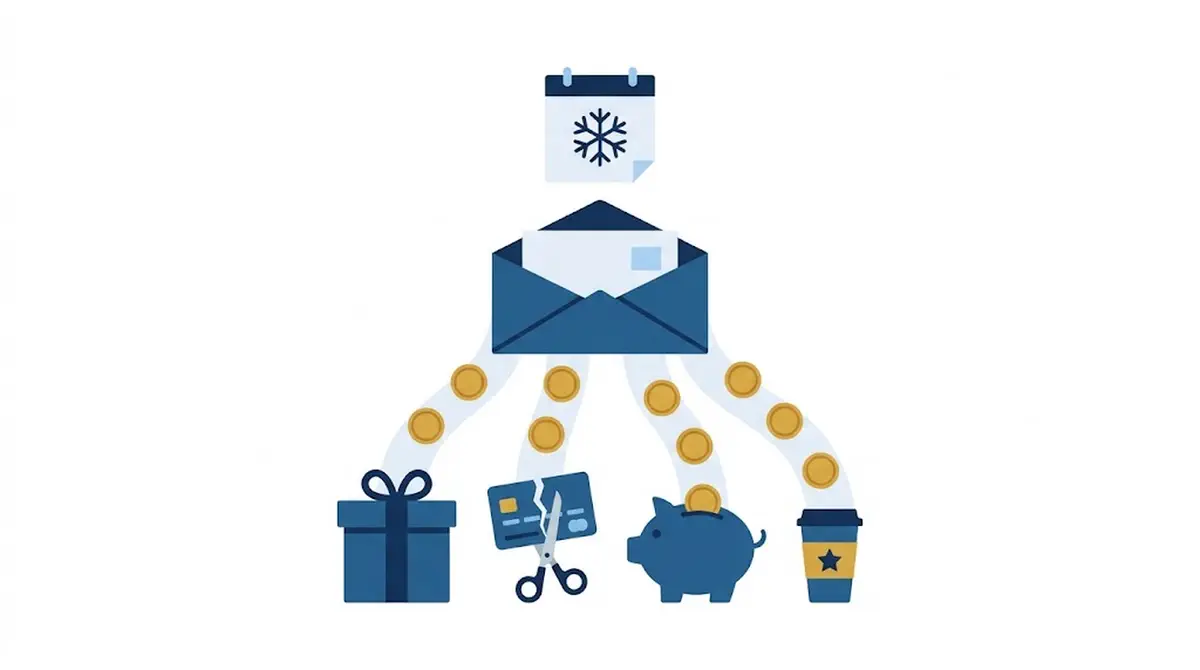
The tip: split it four ways, in this order
Decide the split before the paycheck reaches your account, and move the money the same day it lands. In this order:
- What’s already committed. The big expenses of those months that you’ll pay no matter what: Christmas presents, the insurance that renews in January, property tax, the summer holiday, September’s school fees. Put a number on them and set them aside first. Otherwise they’ll get paid anyway, out of next month’s paycheck.
- Expensive debt. If you have a revolving credit card, an overdraft or any debt at a high interest rate, a good chunk of what’s left goes to paying it down. Paying off debt at 20% is the same as “earning” 20% with zero risk; no savings account pays that.
- Your cushion. If your emergency fund isn’t yet at the number of months of expenses you need, this is where the big remainder goes.
- A treat, with a number on it. A fixed amount to spend on whatever you like, guilt-free. The point isn’t to enjoy nothing, it’s that you set the number, not the card swipe.
An example with numbers
Álvaro takes home €1,700 a month in fourteen payments and owes €700 on a revolving credit card. Before December’s extra paycheck arrives, he sits down for ten minutes and splits it:
- €680 committed: €300 for Christmas presents and €380 for his car insurance, which renews in January.
- €500 to the card, which drops from €700 to €200. That’s €500 he stops paying interest on.
- €340 to the emergency fund.
- €180 treat, for whatever he fancies.
Total: €1,700, the whole paycheck, with a destination before it arrives.
Without a plan, Álvaro’s story would be different: the paycheck dissolves over December, the card stays at €700, and in January the €680 for insurance and presents comes out of his ordinary paycheck. That’s 40% of his January salary. The split doesn’t give him more money: it takes away the slump.
If you genuinely weren’t expecting the money: save it in full
With a tax refund, severance pay, an insurance payout, a bonus or a cash gift the rule is simpler, because no expense was counting on that money. Treat it as if it never reached your everyday account: the same day you see it appear (or earlier, if you know the date), transfer the full amount to wherever it’s supposed to go. Your emergency fund if it’s not full yet; if it already is, a specific savings goal or your most expensive debt. No “I’ll see how much I need and keep the rest”: the rest, mixed in with your regular money, tends to evaporate.
The thing is, your regular money already has a job in your head (rent, groceries, petrol), so you spend it carefully. Money you weren’t expecting has no job assigned yet, which is exactly why it gets spent much more lightly: a dinner out you wouldn’t normally have, that purchase you’d been putting off for weeks “because now there’s room.” It’s exactly as much yours in both cases. Your head doesn’t treat it the same way.
Nor do you need to keep any of it “just in case” in your regular account. That’s what the emergency fund is for: the money is there if you genuinely need it, without competing with your usual balance.
Álvaro and the tax refund. In June he gets a €900 tax refund. If he leaves it in his paycheck account, that month he sees €2,600 available, notices he can afford a treat and has more than one. By the following month maybe €200 of that €900 is left, scattered across expenses he can’t even recall. If he transfers the whole amount to the emergency fund the same day, his everyday account still shows €1,700, as usual. He doesn’t notice any extra room because it’s not in front of him, and the €900 is where he decided it would go.
If you like, keep a small part for a guilt-free treat, just as with the extra paycheck. The key is the same: decide it beforehand, with a clear head, not once the money is already mixed in with the rest.
How to apply it today
- List the expenses that fall around each extra paycheck, in June and July and in December and January. Your last twelve months of statements show them all, including the ones that only appear once a year (recurring household expenses explains how to dig them out).
- Add up what’s committed and subtract it from the paycheck. What’s left is what you can actually split.
- Split that remainder between expensive debt, cushion and treat, with a clear head and before the money arrives.
- The day the paycheck lands, make the transfers. If you know the date, schedule them in advance or automate them.
- Decide now where the next unexpected money will go (the tax refund, a gift), so that on the day it arrives all you have to do is one transfer, for the full amount.
If your collective agreement spreads the extra paychecks over twelve months, no lump arrives in December, but the lump-sum expenses are still there. Then the plan is monthly: set aside one twelfth of those annual expenses each month, so the money is already waiting in December.
How Cuéntamo helps
In Cuéntamo you can add each extra paycheck as a recurring item, just like your regular pay, and do the same with the insurance, the property tax or the holiday. That way the forecast already knows what comes in and goes out in June and December, and shows you what your balance will look like in January before it gets there: if the paycheck was already spent, you see it in November, not in the slump. For money you weren’t expecting, create a savings goal (the emergency fund, a renovation, a trip) and you’ll see at a glance how much is left to reach it; when the refund or the gift arrives, transferring it and marking it as a contribution takes the same time as checking your balance. And the “How much can I spend?” figure on Home comes from that full forecast, so it’s a good starting point for deciding how big the treat can be without going into the red later on.
You can try it for free at cuentamo.com.
Frequently asked questions
Is the extra paycheck extra money?
No. It’s part of your annual salary: the Workers’ Statute entitles you to two a year, one at Christmas and another when your collective agreement sets it. If you take home €1,700 in fourteen payments, your real salary is about €1,983 a month.
Does saving in full work for a small windfall too, like €50 or €100?
Yes. The mechanism is the same even when the amount is small: that money has no job in your head, so it gets spent more lightly than the rest. The same same-day transfer is enough; what matters is the habit, not the size of each windfall.
What if my extra paychecks are spread over twelve months?
Then there’s no lump to split, but the annual expenses still fall in the same months. Set aside one twelfth of what they cost each month, so it’s ready when they arrive.
What if I don’t have any expensive debt?
The split comes down to three parts: what’s committed, the cushion and the treat. If your emergency fund is already full, that part can go to a specific goal (a trip, a renovation) or to a bigger treat, knowing it’s a decision and not an oversight.
I have several debts: which one gets the extra paycheck?
Use the same criterion as in any plan to get out of debt: either the highest-interest one first (you pay less overall) or the smallest one first (you cross it off sooner, which keeps you going). Both methods work with the extra paycheck money.
This article is checked against official sources and reviewed periodically. If you spot anything out of date, email us at [email protected].