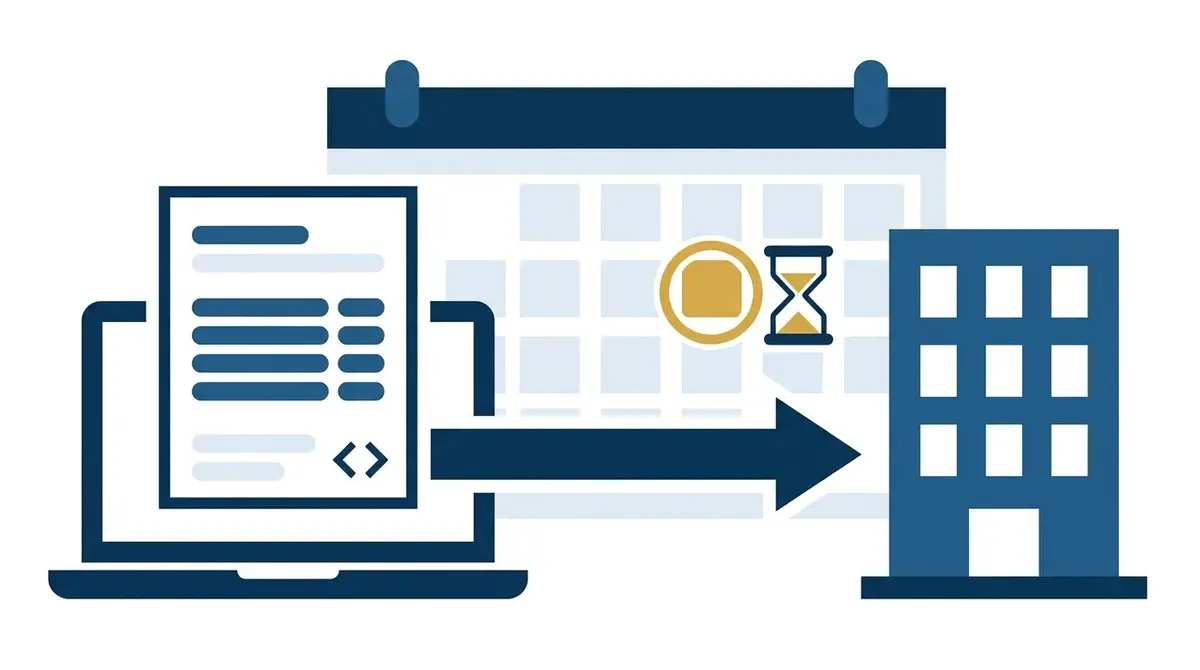
Mandatory e-invoicing for freelancers in Spain: the deadline is now official (October 2028)
You have been issuing invoices as PDFs and sending them by email for years. Your client receives them, archives them, and that is that. The system works. And it is about to change: before 6 October 2028, if you invoice other businesses or professionals in Spain, you will have to do it in structured electronic format.
The uncertainty about the when had lasted four years, ever since Law 18/2022 established the obligation in principle. On 5 October 2026, Order HAC/1028/2026 was published in the Official State Gazette (Boletín Oficial del Estado, BOE), and the clock started: when it came into force on the following day, it triggered the adaptation deadlines.1 No more open windows or “pending regulatory development”: there are now dates.
What B2B e-invoicing is and how it differs from what you do today
The electronic invoice this legislation requires is not a PDF you send by email. A PDF is an image of an invoice; it is readable, but it cannot be processed automatically. What the new obligation requires is a structured data file that the recipient’s software can read, validate and import into their accounting system without manual intervention.
In the Tax Agency’s (Agencia Tributaria, AEAT) public solution, the format is the European semantic model EN 16931 in UBL syntax.1 Private software can also use other accepted formats (Facturae, CII or EDIFACT), but then it has to send the AEAT, at the same moment, a faithful copy in UBL.2 In practice, all of this means an XML file with defined fields (sender, recipient, tax identification number, date, line items, VAT rates, totals) that your software generates automatically if it supports the format. You do not need to understand XML: your program handles it.
This is not entirely new in Spain. Electronic invoicing to public-sector bodies has been mandatory since 2015 (the Factura-e system).3 What changes in 2028 is that the obligation extends to invoices between private businesses and professionals (B2B), not just to invoices issued to the public administration.
The regulation that changed the picture: Order HAC/1028/2026
The legislative history of B2B e-invoicing in Spain goes back a few years:
- Law 18/2022 of 28 September (Ley de creación y crecimiento de empresas, «Crea y Crece») established the general obligation for all businesses and professionals.4
- Royal Decree 238/2026 of 25 March set up the system: who is covered, which formats are valid and the deadlines.2
- Order HAC/1028/2026 of 2 October (published in the BOE on 5 October 2026) regulated the Public Electronic Invoicing Solution (Solución Pública de Facturación Electrónica, SPFE) and, upon entering into force on 6 October 2026, triggered the adaptation deadlines.1
This last step was the missing piece. The delays in publishing the technical regulation and the public platform had kept the calendar in limbo. The publication of the Order ends that uncertainty.
The two dates you need to know
The adaptation deadline depends on the size of the business, measured by the previous year’s turnover:
| Category | Turnover | Deadline |
|---|---|---|
| Large businesses | More than €8 million per year | 6 October 2027 |
| SMEs and freelancers | €8 million per year or less | 6 October 2028 |
The vast majority of freelancers fall into the second group. With a business turning over €40,000 a year, your deadline is October 2028: two years from now to adapt how you issue and receive invoices.
Between October 2027 and October 2028, when large businesses are already in and you are not yet, there is a courtesy rule: if a large business sends you an electronic invoice, it must include a legible PDF, unless you expressly agree to receive only the structured format. During that year you are not left in limbo.2
What you will need to do in practice
The obligation has two sides: sending and receiving.
When sending: your invoices to other businesses or professionals must be generated in the structured format and submitted through the channels the regulation establishes. The AEAT’s SPFE is the public (free) channel managed by the Tax Agency. Private solutions (ERP systems, certified invoicing software) will also be valid if they meet the technical requirements.
When receiving: you must be able to receive and process electronic invoices from your suppliers. This requires that your software understands them or, if you do not use invoicing software, that you use the SPFE as your inbox.
Invoice statuses: the other new feature is that the invoice leaves a trail of what happens to it. The recipient must report if they reject it and when they have paid it in full, and the issuer may report collection or non-payment.1 It is a measure against late payment: the Tax Agency will know who pays late. Self-employed individuals get a grace period: reporting statuses will be voluntary until October 2029, one year after the obligation to issue reaches you.2
The Public Electronic Invoicing Solution (SPFE)
It is the AEAT platform through which invoices (or their copies) and their statuses flow. Using it is free, and the AEAT must also offer a free form to issue e-invoices and report payments: the route designed for people who issue few invoices and do not want to pay for software.2 Access will require an electronic certificate; for the web form, queries and statuses, Cl@ve will also work.1
It must be up and running at least two months before the first mandatory date, that is, by early August 2027 at the latest.1
Who is not affected
The obligation covers invoices you issue to another business or professional established in Spain.2 Out of scope:
- Invoices to private individuals (B2C). If you teach individuals who are not acting as businesses, those invoices stay as they are.
- Clients outside Spain. The rule only reaches recipients with their seat, establishment or residence in Spain.
- Simplified invoices (receipts), except «qualified» ones, which carry the client’s tax number and address because the client asked for them.
Invoices to public administrations follow their own route, Factura-e, which was already mandatory.
If you mix business and individual clients, the obligation only covers the invoices to businesses.
What to do now
If you are a freelancer with a turnover under €8 million, your deadline is 6 October 2028. Nothing is urgent this quarter, but there are four questions worth asking yourself today:
- Will your invoicing software support the new format? Most popular programs in Spain are already in the process of adapting. Check with your software provider whether they have a timeline.
- Will you use the AEAT’s free SPFE or a private solution? If you issue very few invoices, the SPFE may be enough. If you invoice frequently and want integration with your bookkeeping, it is worth comparing options.
- Are your larger clients already in the new system? Companies with more than €8 million in turnover come on board in October 2027. From that date on, you will start receiving some electronic invoices from large suppliers and clients, even though you are not yet required to issue them yourself.
- Do you have up-to-date details for your recipients? Electronic invoices require that the recipient’s details (name, tax number, address) are correct: the XML file validates them.
Frequently asked questions
Does this apply to all freelancers, including those on the flat-rate tax scheme (módulos)? The obligation reaches any business or professional who is required to issue an invoice and issues it to another business or professional in Spain, regardless of how they are taxed.2 If you are on módulos and a business client asks for a full invoice, you are in. If all your clients are private individuals, it does not affect you.
What happens if I keep using PDFs after October 2028? After the deadline, a PDF invoice to another business will no longer meet the obligation to issue it in electronic format. Neither the Royal Decree nor the Order sets a specific penalty for this, so for now the prudent approach is not to assume nothing will happen: both your client and the Tax Agency can ask for it.
Do I need to register somewhere before October 2028? There is nothing to do today. What you will need to use the SPFE is an electronic certificate (or Cl@ve, for the web form), so if you do not have one, get it in good time. And do not wait until the last days of 2028 to find out whether your invoicing software is ready.
Is this different from Verifactu? They are separate regulatory frameworks, though related: B2B e-invoicing regulates the channel and format for issuing invoices between businesses; Verifactu regulates invoicing software systems to guarantee the integrity of records. Until now they had separate calendars, but on that same 5 October the Ministry of Finance announced that it wants to postpone what remains of Verifactu to October 2028, so it coincides with e-invoicing for SMEs and the self-employed, and then bring the two rules closer together. It is a press note, not a law: until it is published in the BOE, the Verifactu date in force for the self-employed is still 1 July 2027. If you use invoicing software, your provider will handle both adaptations; for you in practice, they will translate into software updates, not two independent procedures you have to manage separately.
When will we know the exact technical details of the SPFE? The technical specifications are published on the AEAT’s online office, and the platform must be running at least two months before the first deadline (October 2027).1 For freelancers the date that matters is October 2028, so there is plenty of time.
Sources: Law 18/2022 of 28 September («Crea y Crece») (BOE-A-2022-15818); Order HAC/1028/2026 of 2 October (BOE-A-2026-20587), regulating the Public Electronic Invoicing Solution (published in the BOE on 5 October 2026, in force from 6 October 2026); Royal Decree 238/2026 of 25 March (BOE-A-2026-7295); for a summary in plain language, see also autonomosyemprendedor.es and supercontable.com.
Order HAC/1028/2026 of 2 October, regulating the Public Electronic Invoicing Solution. Published in the BOE on 5 October 2026; in force from 6 October 2026. Format: art. 3; statuses: art. 7; access: art. 10; launch: second additional provision. BOE-A-2026-20587. ↩︎ ↩︎ ↩︎ ↩︎ ↩︎ ↩︎ ↩︎
Royal Decree 238/2026 of 25 March, implementing mandatory electronic invoicing between businesses and professionals. Scope: art. 3; exceptions: art. 4; free of charge: art. 11.10; free form: first additional provision; deadlines: fourth final provision; legible PDF: second transitional provision; statuses for individuals: third transitional provision. BOE-A-2026-7295. ↩︎ ↩︎ ↩︎ ↩︎ ↩︎ ↩︎ ↩︎
Law 25/2013 of 27 December, on promoting electronic invoicing and creating the accounts payable register in the Public Sector. BOE-A-2013-13722. ↩︎
Law 18/2022 of 28 September, on the creation and growth of companies (Ley de creación y crecimiento de empresas). BOE-A-2022-15818. ↩︎