VAT

VAT

Modelo 390: What Spain's Annual VAT Summary Is and How It Ties to Your Quarterly Returns

August 28, 2026

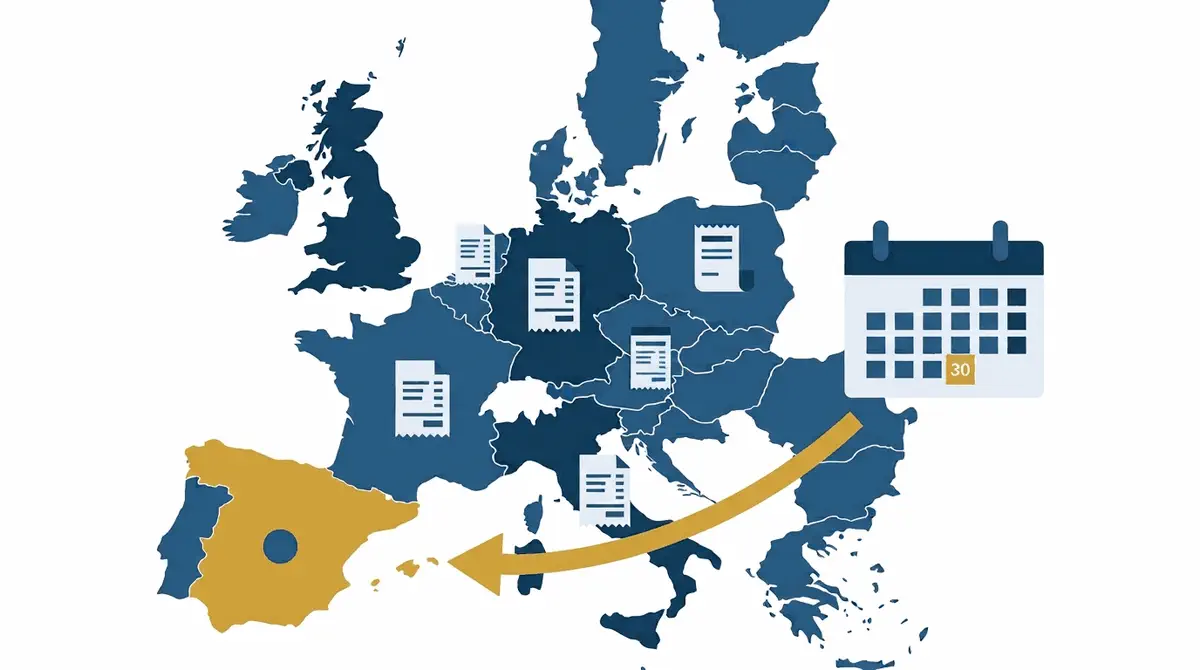
Four quarterly modelo 303 returns, four payments to the Agencia Tributaria, and then at the end of the tax year comes one more declaration: the modelo 390. For many autónomos (self-employed workers) this is the one that generates the most questions — not because it’s complicated, but because it’s not clear what it’s actually for if you’ve already filed all four 303s for the year.

The short answer: the 390 is not a new tax payment. It’s the year-end close. The document that says “here’s everything I charged, everything I paid, and everything I’ve settled with the tax authority over the year, added up”. It’s also your last chance to spot anything in the quarterly returns that doesn’t add up.

self-employed VAT modelo 390 taxes Hacienda annual summary
VAT

A till receipt is not an invoice: when you can deduct it and when you can't

August 24, 2026

You have lunch with a client, pay 48 euros and tuck the receipt into your wallet with a sense of duty done. Three months later, doing your quarterly return, that crumpled piece of paper is worth rather less than you thought: you can deduct the expense, but not the VAT. And not because the receipt is faulty, but because it’s missing one line you can only ask for at the moment you pay.

simplified invoice deductible expenses VAT income tax self-employed
VAT

Depreciation for autónomos: what it is, the official tables and worked examples

May 20, 2026

You’ve just bought a 2,000-euro laptop for your work as an autónomo (self-employed worker). You have the invoice, the IVA (VAT) is clear, and you assume you’ll deduct the whole thing this year like any other expense. But no: that laptop is a capital asset, and for tax purposes it doesn’t work like that.

What you have to do is depreciate it. Spread its cost over several years, following the tables published by the Spanish Tax Agency (Agencia Tributaria). The concept isn’t complicated, but it has its nuances. Let’s break them down.

self-employed depreciation capital assets deductible expenses IRPF VAT
VAT

VAT to offset from previous quarters: what it is and how it works

May 16, 2026

When an autónomo (self-employed worker) files the modelo 303 (the quarterly VAT return), the result of the settlement can be positive or negative. If it’s positive, you pay it to the Spanish Tax Agency (Agencia Tributaria). But if it’s negative –you’ve paid more VAT than you’ve collected– that balance doesn’t disappear: it’s carried forward to the next quarter to offset it. And if you reach the end of the year with an accumulated negative balance, you can ask for it to be refunded.

freelancers VAT modelo 303 offset refund quarterly
VAT

Modelo 303 with no activity: how to file it when you haven't invoiced

May 14, 2026

There are quarters when not a single invoice comes in. A bad month that drags on, a lull between projects, the start of an activity where you still haven’t closed your first client. And when the day comes to file your modelo 303 (the quarterly VAT return), the question is unavoidable: if I haven’t invoiced anything, do I still have to file it?

The short answer: yes. As long as you’re registered in the census of economic activities (modelo 036 or 037), the obligation to file the modelo 303 exists every quarter, with or without income.

freelancers VAT modelo 303 no activity Hacienda
VAT

How to fill in the modelo 303 step by step (a practical guide for autónomos)

May 8, 2026

The modelo 303 is the form that every autónomo (self-employed worker) files each quarter to declare VAT (IVA). If you already know how quarterly VAT is calculated, filling it in is just a matter of knowing which figure goes in each box. And out of the sixty-plus boxes the form has, most of them don’t affect you.

This guide goes box by box, with a real example, so you can sit down in front of the Spanish Tax Agency (Agencia Tributaria) form and complete it without hesitation.

self-employed VAT modelo 303 taxes quarterly Hacienda
VAT

What Input and Output VAT Are, Explained Without the Jargon

April 22, 2026

If you’ve just registered as an autónomo (self-employed worker), or you’ve only been one for a short while, there are two terms that come up constantly and that are worth understanding well from the start: IVA soportado (input VAT) and IVA repercutido (output VAT).

They’re not difficult concepts. They’re difficult to understand when they’re explained in technical language before they have any context. With a concrete example, they fall into place on their own.

self-employed VAT taxation basics
VAT

How to Calculate Your Quarterly VAT Without an Accountant

April 18, 2026

The modelo 303 (the quarterly VAT return) is the form you use to declare VAT every quarter. For many autónomos (self-employed workers) it’s the first tax obligation they face, and also the one that causes the most confusion at first. Not because it’s especially complex, but because nobody explains exactly what you need to fill it in or how the calculation works underneath.

The good news is that the calculation itself is simple. The tricky part, if there’s anything tricky at all, is having your data well organized before you sit down to fill it in.

self-employed VAT modelo 303 taxes quarterly